


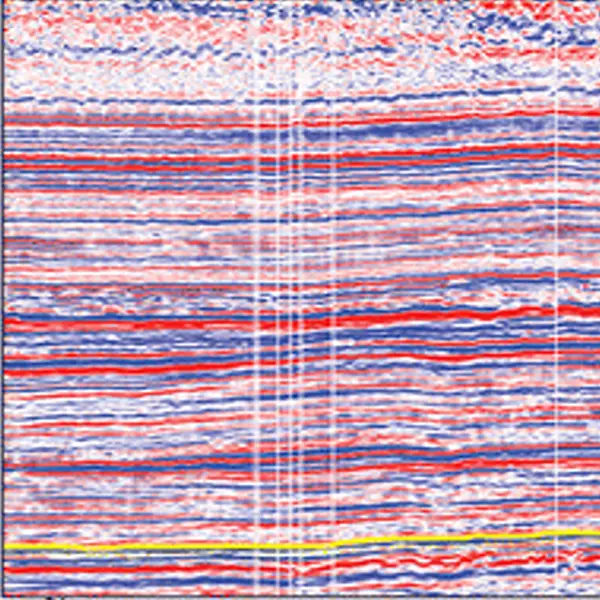


AI-Based 5D Seismic Interpolation
Use Case
Enhancing Subsurface Visibility using AI Generated 5D Seismic Volumes
Business Challenge
Legacy 3D seismic datasets often suffer from limited offset and azimuth coverage, noise interference, and uneven spatial sampling, which reduce their reliability for structural and attribute analysis.
- Sparse spatial sampling is common, with poor inline and crossline density particularly in older datasets.
- Offset and azimuth coverage is often limited, leading to suboptimal amplitude variation with offset (AVO) analysis.
- High noise levels frequently degrade signal clarity and interpretability, especially in pre-stack domains.
- Acquisition gaps and inconsistencies arise due to inaccessible terrains, acquisition design constraints, or budget limitations.
The AI Approach
To address these limitations, the client deployed an advanced seismic interpolation workflow powered by AI, domain-aware signal processing, and intelligent pattern recognition.
- Fourier-based 5D interpolation was used to estimate missing traces across offset and azimuth dimensions using mathematical transforms.
- ML-augmented trace prediction used trained models on valid gathers to identify seismic patterns and reconstruct data in under-sampled areas.
- Noise suppression and amplitude balancing normalized amplitude distributions and improved signal-to-noise ratio (SNR) through pre-processing.
- AVO compatible reconstruction ensured amplitude preservation to support rock property analysis and reservoir characterization workflows.
Project Deployment Overview
Input Data Used
Input data consisted of 3D SEG-Y cubes sourced from mature basin regions with sparse spatial sampling and offset limitations.
Final Output Generated
Reconstructed 5D seismic cubes were produced, featuring balanced offset-azimuth coverage and enhanced spatial continuity.
Deployment Platform
The solution was deployed on the SeisSense AI Engine, utilizing GPU-accelerated architecture for rapid and scalable computation.
Processing Scope
The end-to-end workflow included interpolation, denoising, amplitude balancing, and AVO-consistent conditioning for downstream analysis.
Business Outcomes & Value Unlocked
The AI enhanced seismic workflow delivered measurable operational improvements reducing redundant acquisition costs, enhancing subsurface imaging clarity, accelerating time-to-insight, and enabling data-driven decision-making across geophysical and reservoir teams.

Lowered Acquisition Requirements
Reduced need for new seismic acquisition by 30%, cutting exploration costs significantly.

Boosted Inversion Accuracy
Improved seismic inversion accuracy by 22%, enabling more precise reservoir property estimation.
Faster Interpretation Cycles
Accelerated interpretation readiness by 3X, helping teams make quicker drilling decisions.

Enhanced ROI on Legacy Data
Maximized value from legacy datasets by creating AVO-compliant, analysis-ready volumes.