









AI System Advisor for Well Performance
WellSense™ is an AI-driven workover advisor that unifies production history, failures, economics, and intervention records to identify the right candidates, recommend effective actions, and streamline the entire workflow from diagnosis to portfolio optimization for faster, more confident operational decisions.
Why WellSense™?
Identifies high-value workover candidates using production trends and anomaly signals.
Diagnoses well performance issues through failure overlays and historical insights.
Recommends suitable intervention actions mapped to recurring failure patterns.
Quantifies uplift using AI-based forecasting and probabilistic uplift ranges.
Reduces ineffective interventions and accelerates approval workflows.
Improves collaboration across reservoir, production, and operations teams.
How it works
WellSense™ automates the full workover cycle using structured data, rule-based logic, and ML models to deliver consistent, high-quality results.
- Data Ingestion: Collects production history, failure logs, economics, and intervention records into a unified dataset that supports consistent field-wide analysis and decision-making.
- AI Diagnostics: Identifies anomalies, highlights recurring failure patterns, and classifies well conditions using analytical models that reveal hidden issues affecting performance.
- Candidate Screening: Ranks wells using composite scoring, KPI thresholds, and percentile cutoffs to surface the highest-potential intervention opportunities consistently.
- Intervention Design: Translates diagnostic findings into actionable intervention options using patterns, uplift behavior, and rule-based logic to recommend the most effective job type.
- Economic Evaluation: Calculates uplift, NPV, and payback while comparing intervention scenarios using forecasting models that reduce uncertainty and strengthen decisions.
Key Modules of WellSense™
Designed to make well workover planning easier and faster.
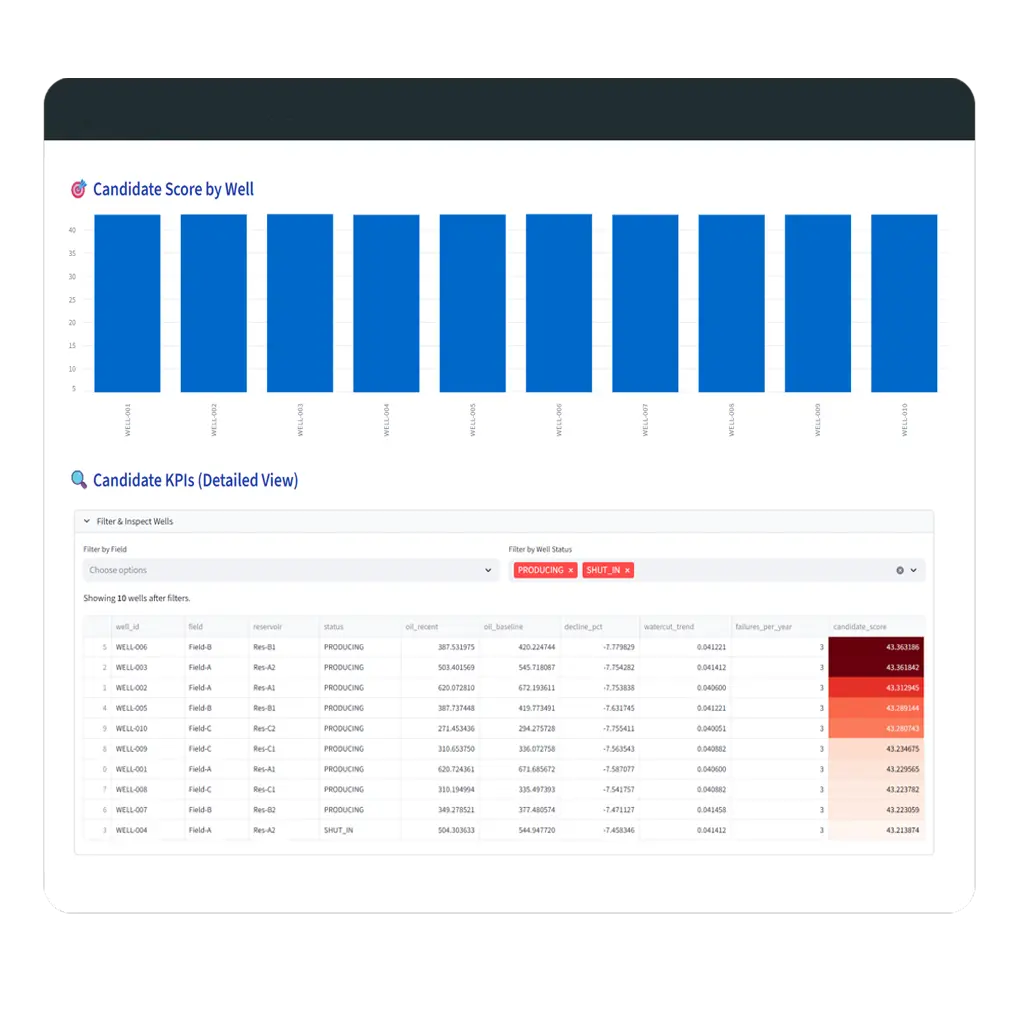
Screen and Rank Wells with Smarter Scoring
• Analyzes production history to generate reliable performance KPIs. • Flags wells showing decline through clear behavioral trend analysis. • Combines failure events and downtime into one unified view. • Calculates health scores using percentile thresholds across fields. • Identifies wells offering strong uplift potential for intervention. • Provides adjustable filters for horizon, cutoffs, and screening priorities. • Produces a ranked list enabling faster, consistent candidate selection.
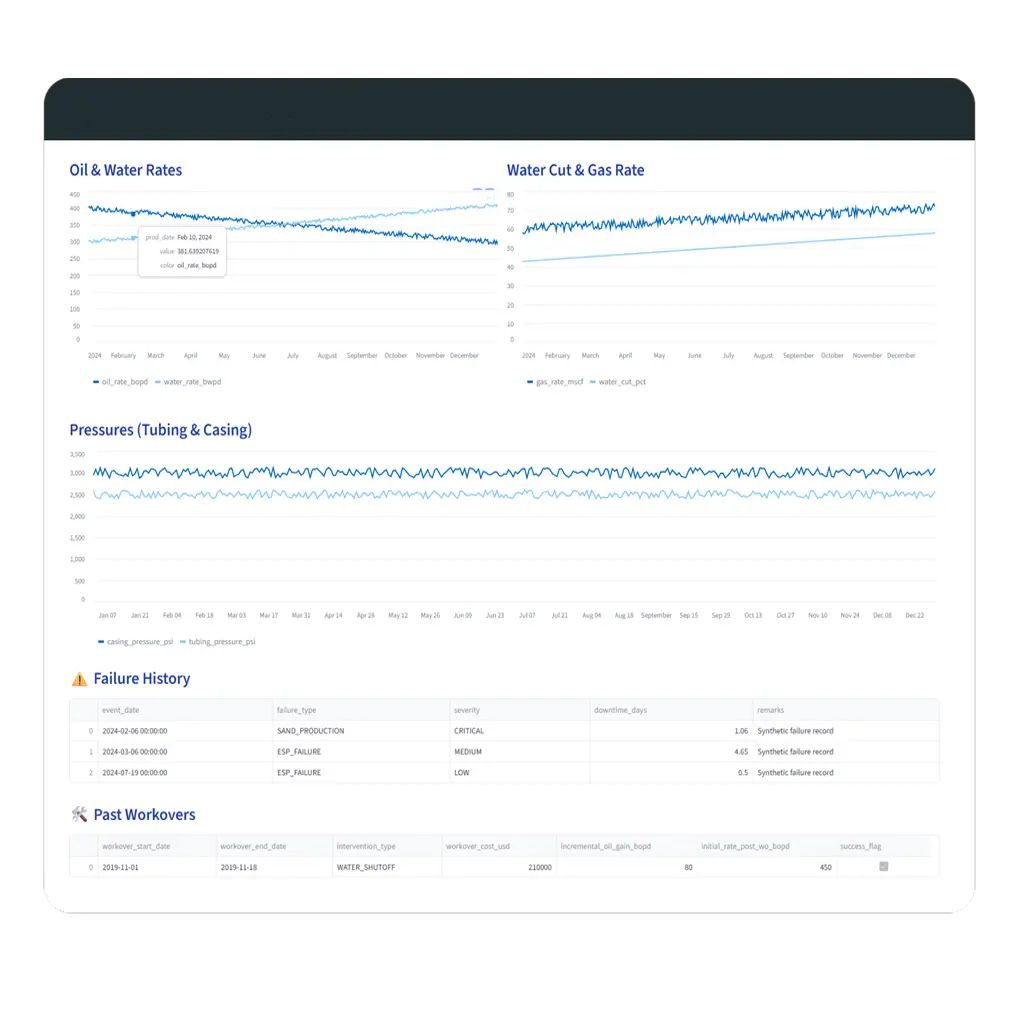
Understand Why Wells Underperform Faster
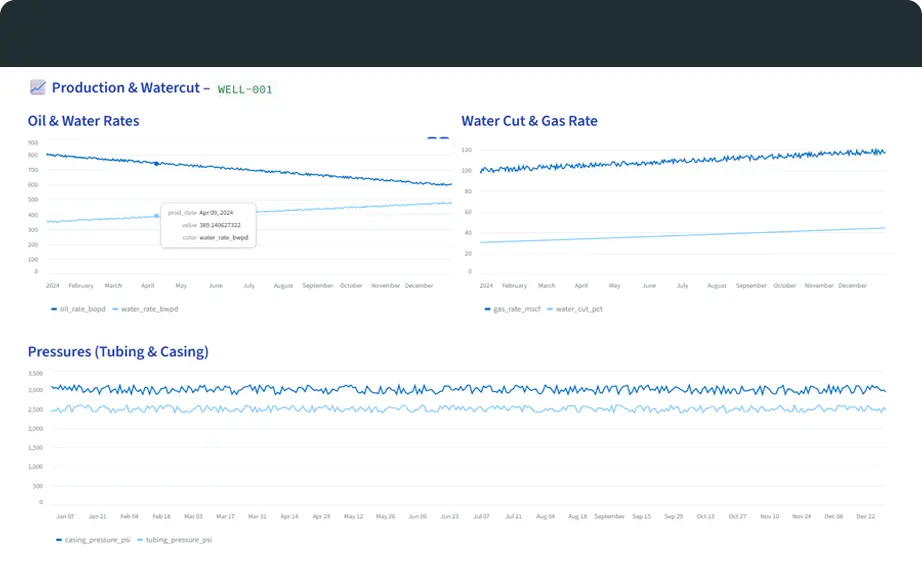
• Displays production curves with KPIs for quick performance review. • Overlays failures, downtimes, and run-life information for clarity. • Detects anomalies using machine learning models for deeper insights. • Shows cumulative oil and water-cut trends across time windows. • Summarizes months on production with stability indicators included. • Allows comparison across offset wells for consistent evaluation. • Helps identify root causes behind production decline efficiently.
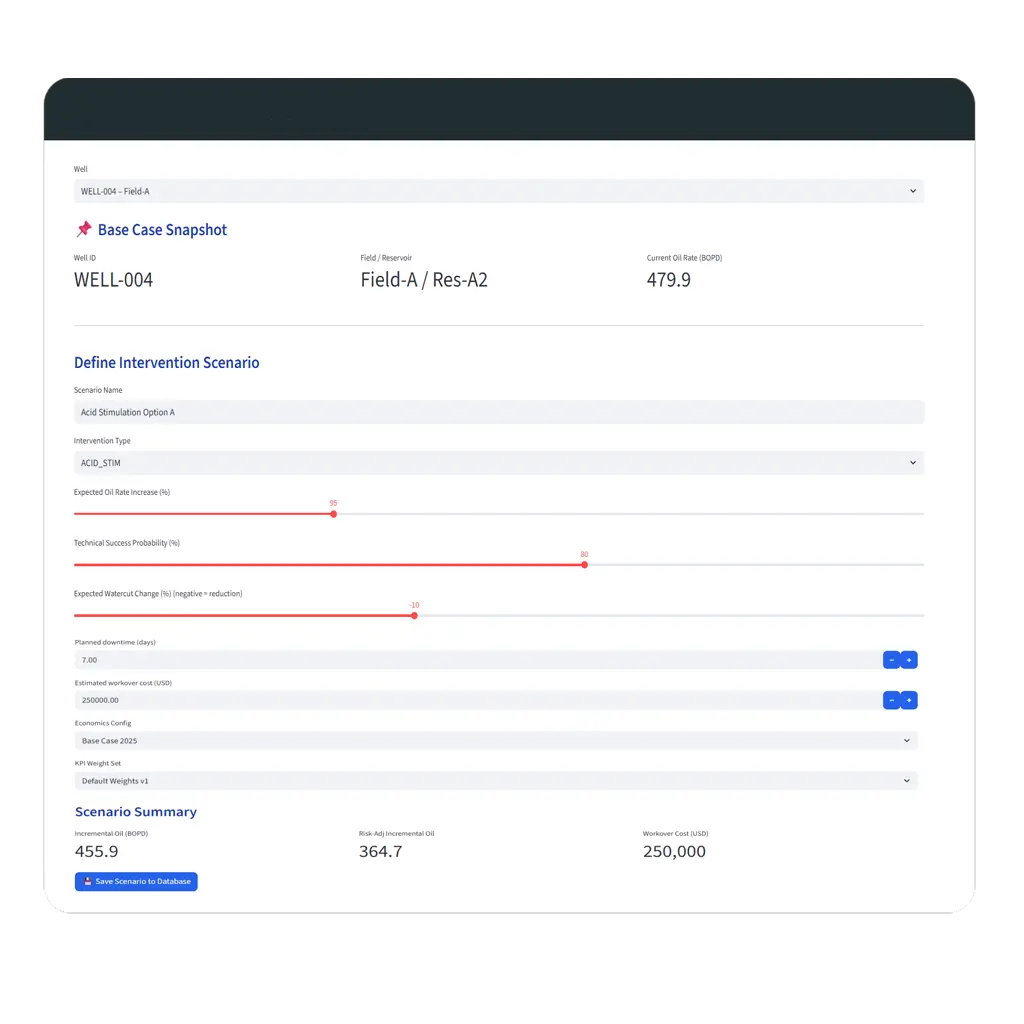
Design Better Data-Driven Interventions
• Maps diagnostic patterns directly to recommended intervention types. • Applies rule-based logic using historical uplift distributions effectively. • Generates draft intervention scenarios automatically for engineer review. • Captures job steps and required resources for planned interventions. • Integrates failure history to prevent repeating ineffective interventions. • Compares alternative job options using clear decision-support insights. • Ensures consistent workflows across intervention planning and approvals.
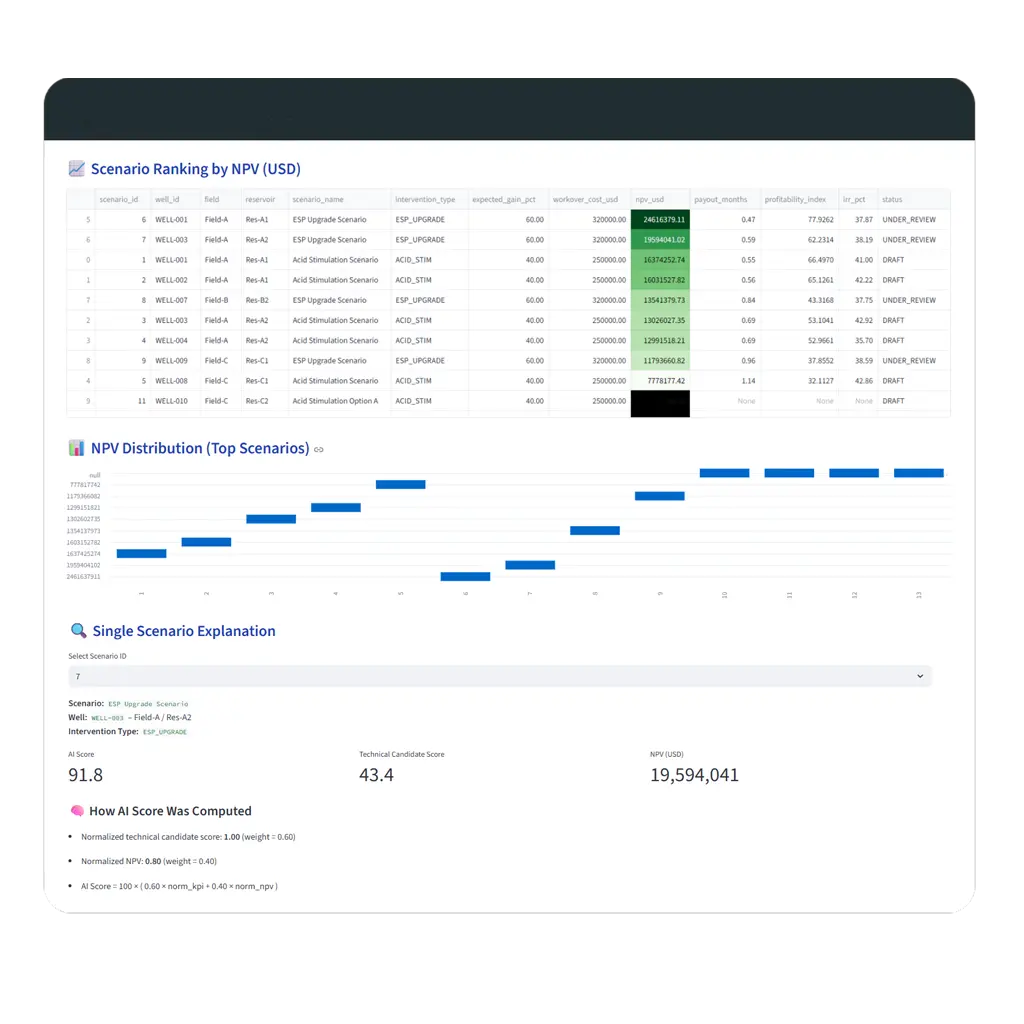
Prioritize the Highest-Value Workovers
• Calculates uplift, NPV, and payback for every scenario. • Ranks wells using value scores and cost effectiveness. • Applies budgets and operational limits with simple configuration. • Builds optimized workover portfolios with deterministic logic. • Highlights high-value opportunities and quick-win workover candidates. • Connects planning outputs to workflow tracking for improved execution. • Supports confident selection with clear scenario comparisons.

Features of WellSense™
Improves well workover planning with straightforward insights and helpful analytics.

AI-Based Anomaly Detection
Uses IsolationForest and KPI clustering to detect wells off expected behavior and surface candidates missed by screening.

Production Forecasting Engine
RandomForest forecasting models generate uplift projections and ranges, improving confidence in NPV estimates and planning.
Failure Signature Mapping
Combines historical failures with intervention results to map patterns to the most suitable recommended actions.
Intervention Intelligence Library
A structured knowledge base of actions, job steps, uplift distributions, and cost templates generated from actual field data.
Workflow Management & Lifecycle Tracking
Tracks approvals, timestamps, execution status, and post-job performance across the entire workover lifecycle.

Workover Performance Analytics
Evaluates pre- and post-job performance to validate uplift, identify ineffective jobs, and refine future recommendations.
Inspirational Insights Client Stories
From pilot runs to full-scale deployment, see how SeisSense™ drives value in real operations.
FAQs on WellSense™ Platform
What data does WellSense™ need to deliver accurate screening, diagnostics, and intervention recommendations?
WellSense™ works best when it has access to production history, downtime logs, failure events, workover records, and economic inputs. It can also pull optional sources like SCADA, PI, CMMS, and integrity data to improve prediction accuracy and provide deeper insights.
How does WellSense™ identify the best wells for intervention across large and complex fields?
WellSense™ uses KPI scoring, percentile thresholds, anomaly detection, and health scoring to evaluate every well objectively. This helps surface high-potential candidates quickly, even in fields with thousands of wells and inconsistent performance patterns.
How accurate are the uplift estimates and NPV calculations generated by WellSense™?
Uplift forecasts in WellSense™ use RandomForest models trained on your field’s historical intervention outcomes. These models generate ranges and confidence scores to help engineers understand expected value and uncertainty before planning a workover.
Can WellSense™ integrate with existing systems like SCADA, CMMS, or production databases?
Yes. WellSense™ integrates with SCADA, PI, SAP, Maximo, and internal production databases. It supports both API-based and file-based ingestion so it can fit easily into your current operational ecosystem.
Does WellSense™ support cloud and on-premise deployments for sensitive environments?
Yes. WellSense™ can be deployed on cloud, on-premise, or fully air-gapped setups depending on your IT and security requirements. All deployment models offer the same features, performance, and updates.
Can engineers override WellSense™ recommendations when needed?
Yes. WellSense™ supports human-in-the-loop workflows. Engineers can override recommendations, adjust scenarios, or apply operational judgment. The platform records these changes to maintain traceability and strengthen decision consistency.