Well intervention can restore, maintain or improve production from a completed well without drilling a replacement. The value comes from diagnosing the cause of underperformance, matching it to the right intervention and ranking the opportunity on economics, and not simply choosing the lowest producing well.
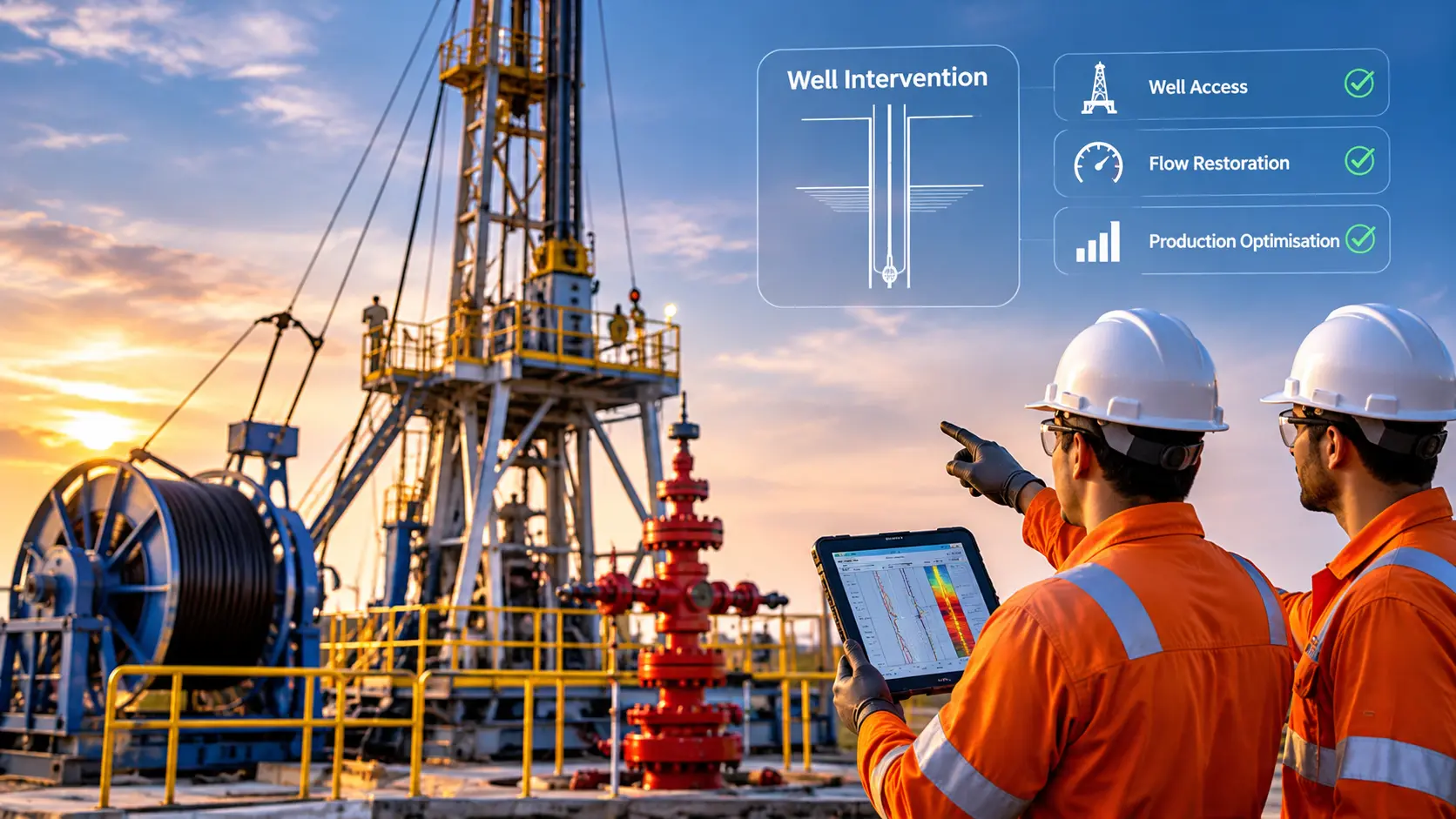
Diagnose the cause, select the treatment and measure the result.
- Intervention can recover production from existing wells, often with lower cost and shorter lead time than new drilling.
- The treatment must match the cause: remove scale, clean out fill, isolate unwanted water or gas, or restore artificial lift.
- Screen candidates by expected incremental production, cost, risk and payback, not by production decline alone.
- Diagnose first using production logs, pressure data, well history and nodal analysis; measure results after the job.
What is well intervention?
Well intervention is work performed on a completed oil, gas or injection well to diagnose its condition, restore performance or change how it produces, without undertaking a full drilling campaign. It can be carried out onshore or offshore and is commonly grouped into three categories:
| Type | Typical work | Typical examples |
|---|---|---|
| Light | Wireline or slickline work, often with the well under pressure | Gauge runs, production logging, plug setting, perforating and valve changes |
| Medium | Coiled tubing and other through-tubing operations | Cleanouts, nitrogen lift, acid placement and zonal isolation |
| Heavy | Hydraulic workover or rig-based operations | Tubing replacement, casing repair, recompletion or sidetracking |
Why do wells underperform?
Production symptoms help narrow the diagnosis, but they do not prove the cause. Match well tests, pressure data, logs and intervention history before selecting a treatment.
| Cause | Typical symptom | Common intervention |
|---|---|---|
| Scale | Falling rate, rising drawdown or restricted tubing | Chemical dissolver, acid wash or mechanical milling |
| Sand / fines | Rate drop; fill above perforations | Coiled tubing cleanout or sand-control repair |
| Formation damage | High skin or reduced inflow | Matrix acidizing or solvent treatment |
| Water / gas breakthrough | Rising water cut or GOR; falling oil rate | Zonal isolation, packers, gel or cement squeeze |
| Declining pressure | Gradual decline and low flowing pressure | Artificial-lift upgrade or pressure support |
| Mechanical failure | Sudden rate loss; pump or valve failure | Pump, tubing, valve or completion repair |
| Wax / asphaltene | Rising wellhead pressure or flow restriction | Hot oil, solvent, scraping or inhibitor programme |
Which intervention method fits which problem?
Wireline is generally suited to diagnostics and light mechanical work; coiled tubing supports live-well cleanouts and treatments. Rig-based work is usually reserved for jobs requiring tubing to be pulled or more extensive completion work.
| Method | Best suited to | Well live? | Relative cost / speed |
|---|---|---|---|
| Slickline / e-line | Logging, plugs, perforating, valve changes | Usually yes | Low / fast |
| Coiled tubing | Cleanouts, acid placement, nitrogen lift, isolation | Often yes | Medium / medium |
| Matrix stimulation | Near-wellbore damage or scale | Often yes | Low–medium / fast |
| Hydraulic workover | Tubing or lift replacement, casing repair | Usually no | High / slower |
| Rig workover / sidetrack | Major recompletion, new interval or lateral | No | Highest / slowest |
How do you select and rank candidate wells?
A disciplined screening process helps focus limited intervention budgets on the wells with the strongest risk-adjusted returns:
- Build the candidate list: Flag wells below historical, offset-well or modelled performance.
- Diagnose the cause: Use production logs, pressure surveys, nodal analysis, water-cut trends and well history.
- Estimate the gain: Forecast incremental oil or gas and apply a realistic post-job decline profile.
- Estimate cost and risk: Include mobilization, deferred production, probability of success and failure downside.
- Rank the economics: Compare payback, NPV and incremental barrels per dollar invested.
- Measure and learn: Compare actual results with forecasts and update screening assumptions.
Well intervention vs workover vs drilling a new well
Intervention is generally lower-cost and faster, but it does not create new drainage in the way a new well can. The right choice depends on whether the constraint is in the wellbore, completion or reservoir.
| Option | Relative cost | Typical lead time | Adds reserves? | Best suited to |
|---|---|---|---|---|
| Light / medium intervention | Low | Days–weeks | No; accesses existing potential | Near-wellbore issue; sound mechanical condition |
| Workover | Medium–high | Weeks–months | Sometimes | Damaged completion or accessible new interval |
| New / infill well | Highest | Months–years | Yes | Undrained reservoir potential justifies capital |
Note: Cost and lead-time ranges are indicative. Actual values vary by location, water depth, rig market, well design and service availability. Use field-specific AFE estimates for decisions.
Common mistakes to avoid
- Treating the symptom: Acidizing a well with water breakthrough may waste cost and worsen water production.
- Skipping the baseline: Without a pre-job test, the production gain cannot be reliably measured.
- Ignoring deferred production: Shut-in time during the job can materially extend payback.
- Chasing the worst well: The lowest producer is not necessarily the best economic candidate.
- Skipping post-job review: Without comparing forecast and actual results, teams lose the opportunity to improve future selections.
Conclusion
Underperforming wells can remain valuable assets when the cause of lost production is understood, and the intervention is technically appropriate and economically justified. The strongest programmes combine reliable diagnostics, disciplined candidate ranking, realistic production forecasts and post-job measurement. The goal is not to intervene in more wells; it is to make each intervention deliver measurable, sustainable value.
The goal is not to intervene in more wells; it is to make each intervention deliver measurable, sustainable value.
Make every intervention deliver measurable value.
Combine reliable diagnostics, disciplined candidate ranking, realistic production forecasts and post-job measurement so that each intervention is technically appropriate and economically justified.
Talk to our team