Substations bring together the equipment and control systems that keep electricity networks operating. Yet drawings, asset registers, SCADA measurements, protection events, inspection reports and maintenance histories are often held in separate systems. A substation digital twin connects physical assets, electrical relationships, operating states and asset intelligence to give teams a more complete context for reliability and maintenance decisions.
The substation visibility challenge
Substations are critical nodes in electricity networks. They transform voltage, switch circuits, protect equipment and provide the interfaces through which power is controlled and distributed. Their reliability depends on many interconnected assets and systems, including transformers, circuit breakers, isolators, busbars, protection and control equipment, batteries, auxiliary supplies and communications infrastructure.
Yet information about these assets is often fragmented. Electrical drawings, asset registers, SCADA measurements, protection events, inspection reports, maintenance histories and condition-monitoring systems may sit in separate applications. Teams can see individual alarms or records without having a complete picture of how an asset's condition, operating context and maintenance history relate to the wider substation.
This fragmentation makes it harder to understand developing risks, investigate recurring problems, prioritise maintenance and assess the operational consequences of equipment degradation. The opportunity is to move beyond isolated monitoring towards a connected digital representation of the substation.
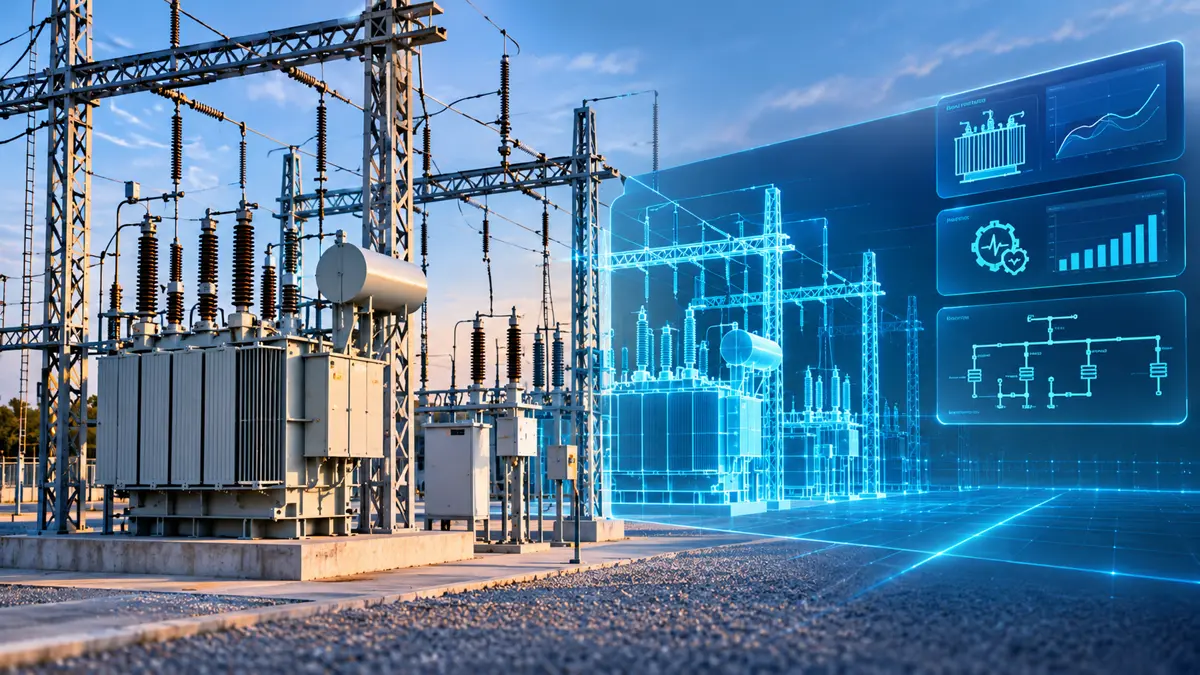
From static asset models to a living digital twin
A substation digital twin is more than a three-dimensional model or a digital drawing. It is a structured representation of the physical substation, its assets, electrical relationships, operating states and relevant condition information. When connected to trusted engineering data and operational systems, it can provide a consistent context for understanding what is installed, how equipment is connected, how it is performing and what has changed.
The twin should bring together three complementary layers. The physical and engineering layer describes equipment, ratings, configuration, connectivity and location. The operational layer adds telemetry, alarms, switching states, electrical measurements and event history. The asset-intelligence layer combines inspection results, condition indicators, maintenance records, failure history and risk assessments. The value emerges when these layers are linked, not simply displayed side by side.
What should a substation digital twin cover?
A useful scope begins with the assets and relationships that matter most to safe and reliable operation:
- Power transformers: Loading, temperature, cooling-system status, condition indicators and maintenance history.
- Circuit breakers and switchgear: Operating counts, trip events, mechanism condition, alarms and inspection records.
- Busbars, isolators and feeders: Electrical connectivity, configuration, loading context and switching relationships.
- Protection and control: Relay events, settings governance, disturbance records and control-system status.
- DC batteries and auxiliary systems: Battery condition, charger status, auxiliary supply availability and alarms.
- Site infrastructure: Environmental conditions, physical inspections, access constraints and relevant civil asset information.
The twin's scope should reflect the substation design, available instrumentation, data quality and operational priorities. Not every asset will have continuous condition monitoring. Where live data is unavailable, validated inspection records and periodic measurements can still contribute, provided their source and age are visible.
Connect asset health to predictive maintenance
Traditional maintenance is commonly organised around fixed intervals, inspection programmes and corrective work after faults. These remain essential, but they may not reveal deterioration developing between inspections. A digital twin can help bring condition indicators, operating stress, alarms and maintenance history into one asset context.
For example, a transformer showing repeated high-temperature periods can be assessed alongside loading, cooling-system alarms, historical trends and maintenance findings. A circuit breaker with an unusual pattern of operations can be reviewed against operating duty, trip records, inspection results and previous interventions. Analytics may identify anomalies or rank assets for closer investigation; engineering teams must validate the diagnosis and decide the appropriate action.
The objective is not to automate safety-critical decisions. It is to improve the quality and timing of engineering judgement, direct inspections towards assets with stronger evidence of risk and reduce avoidable reactive maintenance.
Make engineering and maintenance workflows part of the twin
A digital representation becomes operationally valuable when it supports work, not just observation. Asset-level alerts and findings should be traceable to inspections, defect notifications, work orders, maintenance plans and completed interventions. Teams should be able to see what was identified, who assessed it, what action was approved, what work was completed and whether the condition improved.
This creates a feedback loop: operational events and inspections update asset understanding; maintenance actions change the recorded condition and history; subsequent measurements help verify whether the intervention was effective. It also improves handovers between control-room operators, asset engineers, maintenance planners and field crews.
Connect substation data to the decisions that improve reliability.
Bring engineering records, electrical connectivity, operating conditions and maintenance history into one trusted asset context. Use that connected view to support risk-based inspections, coordinated maintenance workflows and better-informed engineering decisions.
Talk to our teamMeasure value through reliability and lifecycle performance
A substation digital twin should be assessed through measures that show whether it improves asset visibility, maintenance effectiveness, operational performance and lifecycle decisions. The following areas provide an illustrative measurement framework:
| Value area | Illustrative measures |
|---|---|
| Availability and reliability | Unplanned outages, equipment failure frequency, restoration duration |
| Asset health | Condition trends, critical alarms, defects and overdue inspections |
| Maintenance effectiveness | Planned-to-reactive work ratio, repeat defects, work-order closure |
| Operational performance | Loading, equipment duty, alarm response and event investigation time |
| Lifecycle management | Asset risk ranking, intervention cost, remaining-life assessment confidence |
Start with a bounded, trusted implementation
A practical programme should begin with a defined substation or asset class and a clear operational question, for example, improving transformer condition visibility or reducing recurring breaker-related outages. Establish the asset hierarchy, validate drawings and connectivity, identify authoritative data sources, connect selected operational and maintenance information, and agree how findings will be reviewed and acted upon.
Data ownership, cybersecurity, access control, engineering change management and model validation are foundational. The digital twin must reflect approved configurations and clearly distinguish live measurements, calculated indicators, historical records and engineering assumptions. It should complement, not replace, SCADA, protection systems, asset-management applications or established safety procedures.
From digital representation to better substation decisions
A substation digital twin is most valuable when it connects physical assets, electrical topology, operating data and maintenance activity into a dependable engineering context. It can help utilities understand asset condition, investigate events, prioritise interventions and preserve knowledge across operational teams.
The goal is not a more elaborate visualisation. It is better-informed decisions that improve substation availability, reduce avoidable failures and support the long-term performance of critical network infrastructure.
The goal is not a more elaborate visualisation. It is better-informed decisions that improve substation availability, reduce avoidable failures and support the long-term performance of critical network infrastructure.