Shut-in production represents a visible opportunity in upstream operations, but the headline volume can conceal a complex mix of technical, operational and commercial constraints. Wells may be inactive because of mechanical or artificial-lift failures, integrity concerns, reservoir or near-wellbore conditions, facility constraints, planned maintenance, evacuation limitations or unresolved dependencies. AI can help turn fragmented well information into a prioritised recovery programme, but engineering evidence remains the basis for decisions.
The opportunity in shut-in wells
Each shut-in well has its own history and reason for inactivity, and each cause calls for a different diagnosis and recovery pathway. A mechanical or artificial-lift failure, an integrity concern, a reservoir constraint and a facility bottleneck cannot be treated as the same problem.
A shut-in well is not automatically a recoverable well. Historical production, a prior test rate or an estimated potential does not prove that the same rate can be restored today. Operators need to establish the well's current condition, reservoir deliverability, completion status, safety barriers, surface infrastructure and available evacuation capacity before assigning a recovery case.
Build a trusted, AI-ready well inventory
The first step is a reconciled well-level inventory. Information is often distributed across production databases, well files, daily reports, well-test results, workover histories, integrity records, completion diagrams, maintenance systems and operator spreadsheets. AI-assisted document extraction and information classification can accelerate the assembly of this evidence, identify missing fields and flag conflicting records for review.
A consistent well record should bring together the information needed to understand status, condition, dependencies and evidence:
- Well identity, location, current status, last production date and shut-in date and reason.
- Historical and recent production rates, well-test results and available deliverability evidence.
- Integrity status, completion and artificial-lift configuration, and intervention history.
- Facility dependencies, evacuation constraints and supporting technical records.
Data lineage and confidence should remain visible. AI-extracted information must be checked against authoritative records before it is treated as confirmed.
Use AI to strengthen diagnosis
The event that caused a well to stop producing may not be the underlying cause, and the root cause may not be the only barrier to restart. AI can help analyse production trends, pressure and test data, alarm histories, workover reports and equipment records to identify patterns, compare similar cases and generate evidence-backed diagnostic hypotheses.
- Mechanical and artificial-lift issues: Identify performance patterns associated with pump, tubing, completion or lift-system problems.
- Well integrity and safety: Organise barrier, corrosion and pressure-containment evidence and flag records requiring engineering assessment.
- Reservoir and near-wellbore conditions: Analyse deliverability trends, production decline and available diagnostic evidence.
- Facilities and evacuation: Correlate well performance with flowline, gathering, processing, power and export constraints.
- Operational and external dependencies: Identify outstanding maintenance, service, approval or commercial actions that may delay restart.
These outputs are decision support. Models can rank likely causes and indicate confidence, but they cannot replace well integrity assessments, diagnostic testing, petroleum engineering review or required safety approvals.
Predict recoverability and prioritise interventions
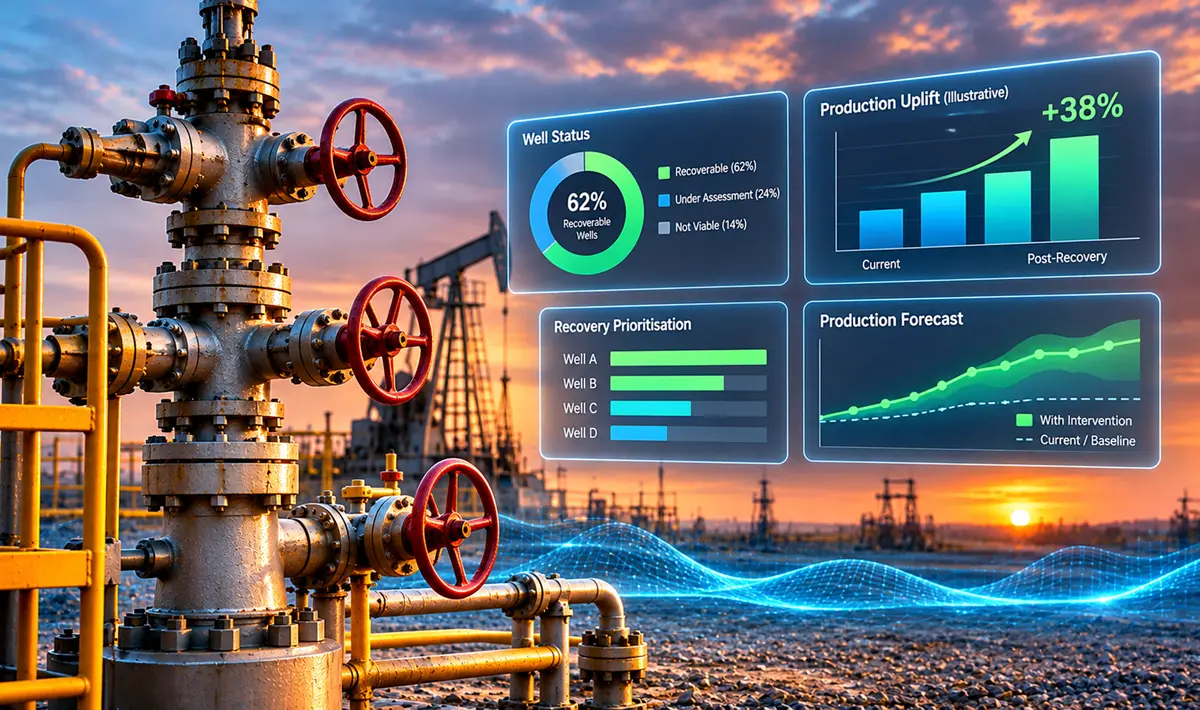
Once the evidence is assembled, predictive analytics can support estimates of achievable production, time to first production, intervention complexity and the likelihood of sustained recovery. A prioritisation model can combine expected incremental rate with data confidence, intervention cost, technical risk, readiness, facility capacity and time to execute.
This helps distinguish wells with near-term, lower-complexity recovery potential from candidates requiring substantial work or further investigation. Production measures must remain distinct: historical rate, assessed potential, technically recoverable rate, forecast rate, constrained rate and verified incremental production are not interchangeable.
AI-generated estimates should show assumptions, uncertainty ranges and the data used. Low, base and high cases, followed by engineering review and bottleneck checks, create a more defensible portfolio than a single automated ranking.
Turn shut-in well inventories into evidence-led recovery portfolios.
Connect well history, integrity evidence, production analytics, intervention readiness and facility constraints to rank recovery candidates, while keeping diagnosis and safety-critical approvals under engineering control.
Talk to our teamSupport intervention planning and execution
AI-enabled planning can help assemble candidate intervention options, retrieve relevant offset-well and workover lessons, identify long-lead materials, highlight schedule dependencies and compare cost and production scenarios. Optimisation methods can assist with sequencing work across rigs, service crews, equipment and facilities, subject to operational constraints and approved plans.
Each selected well should have an accountable intervention plan covering scope, engineering basis, materials and services, approvals, cost, schedule, dependencies, safety requirements and expected production profile. Progress can be tracked through clear milestones:
- Data validated and diagnosis completed.
- Intervention approved and resources ready.
- Work commenced and intervention completed.
- Restart authorised and first production achieved.
- Sustained production verified.
Close the loop with production intelligence
A completed workover or successful restart is not the same as sustained incremental production. After restart, analytics can compare actual rates with the approved forecast, detect abnormal performance, identify early decline or recurring equipment issues and flag production shortfalls for investigation. Measurement should use validated production and allocation records, with relevant facility or export reconciliation.
A recovery scorecard should connect operational progress to measured production and economics:
| Performance area | Measures to track |
|---|---|
| Portfolio readiness | Wells with validated data; wells assessed; interventions approved |
| Execution | Interventions completed; time to first production |
| Production outcome | Measured incremental barrels per day; sustained production over an agreed period; forecast-to-actual variance |
| Economic performance | Intervention cost; cost per incremental barrel; revenue estimates based on verified production and transparent commercial assumptions |
AI can identify patterns across the portfolio and highlight where actual outcomes differ from expectations. Revenue estimates should be based on verified production and transparent commercial assumptions.
Success is not the size of an initial shut-in estimate, the number of interventions launched or an algorithm's predicted rate. It is verified and sustained incremental production, delivered safely and economically.
Human-governed AI: from dormant inventory to managed recovery
The strongest model combines AI's ability to process large volumes of fragmented information, identify patterns and continuously monitor performance with the judgement of petroleum engineers, production technologists, well integrity specialists and intervention teams. AI can recommend, rank, explain and monitor; authorised professionals validate diagnoses, approve interventions and retain accountability for operational and safety-critical decisions.
The objective is to move from manually managing a list of shut-in wells to an AI-enabled, continuously optimised recovery programme. The measure of success is verified and sustained incremental production, delivered safely and economically.