Routine gas flaring is often treated as a narrow emissions problem. In practice, it is also a production, asset-management and commercial problem. Operators burn associated gas when it cannot be safely or economically used, transported, reinjected or stored. Ending routine flaring therefore requires more than a target: it requires reliable measurement, continuous monitoring and a credible route to market for the gas.
The scale of the problem
The World Bank’s 2026 Global Gas Flaring Tracker estimates that 167 billion cubic metres (bcm) of gas were flared globally in 2025, the highest level since 2019. It estimates the potential value of that gas at about US$54 billion. These figures illustrate the scale of the opportunity, but they do not mean every flare can be eliminated at a positive return: location, gas composition, volume, infrastructure, reliability of demand and financing all matter. Routine flaring also needs to be distinguished from flaring for safety or during genuine emergencies.
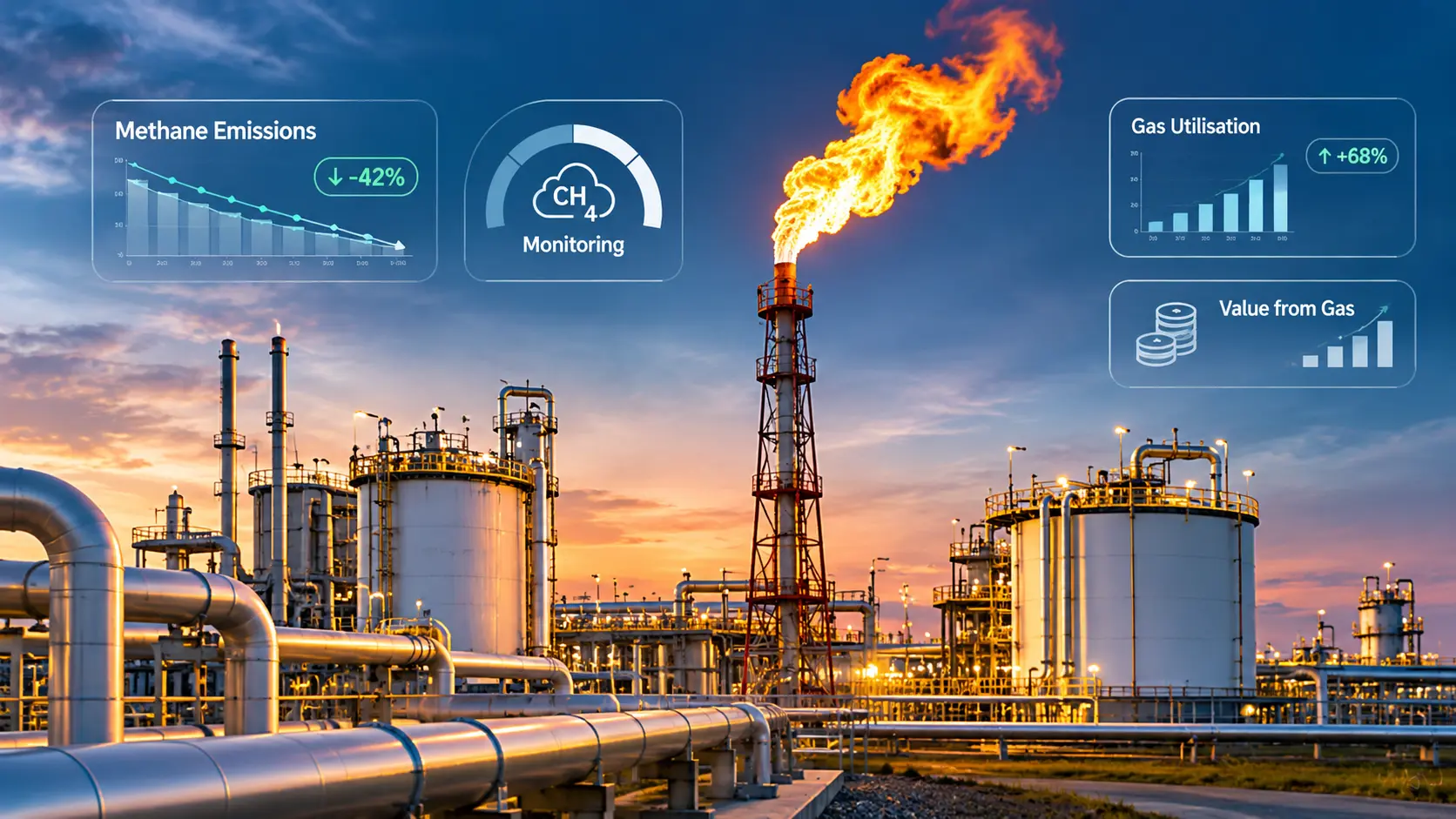
Measurement: establish what is actually being lost
An operator cannot manage what it cannot quantify. A credible baseline starts with measured gas volumes at the well pad, gathering station, processing facility and flare header, supported by gas composition, operating hours, flare status and production data. Metering should be reconciled with engineering calculations and production balances; unexplained differences should trigger investigation rather than be hidden in a single monthly estimate.
Methane measurement needs a separate but connected approach. A flare primarily converts methane into carbon dioxide and water, but incomplete combustion can leave unburned methane. Leaks and intentional venting release methane without combustion and must not be counted as if they were flare emissions. Operators should combine equipment and source-level measurements, leak detection and repair (LDAR), periodic surveys and independent data such as aircraft or satellite observations where appropriate.
Monitoring and verification: move from periodic reports to operational control
Measurement establishes the baseline; monitoring shows whether performance is changing and where action is needed. A practical monitoring system links flare flow, pressure, temperature, pilot status, combustion performance, equipment alarms, maintenance events and production changes. Exception alerts can identify persistent flaring, unexpected increases, abnormal flare operation or recurring equipment failures. Site teams should investigate alerts, record the cause, document corrective action and verify the result.
Reporting methods should mature with data quality. National inventories may use IPCC Tier 1 default factors, Tier 2 country-specific factors or Tier 3 facility and source specific methods, depending on available data and methodological requirements. For company-level methane reporting, UNEP’s OGMP 2.0 framework encourages a shift from generic emission factors towards increasingly measurement-based reporting, with data quality assurance. Satellite observations are valuable for identifying large events and checking trends, but they do not replace site-level measurement or operational investigation.
Monetisation: make captured gas usable and bankable
Capturing gas is only the first step. The preferred route depends on volume, pressure, composition, distance to market and reliability of offtake. Options include connecting to a gathering or transmission pipeline, supplying nearby industrial or power users, processing for LPG and natural gas liquids, using compressed or liquefied gas for transport, reinjecting gas where technically and economically suitable, or deploying modular solutions for smaller and remote fields. Gas quality, compression, dehydration, liquids handling and metering must be included in the project design.
| Commercial question | Why it matters |
|---|---|
| Is there dependable demand? | A technically sound project can fail without a creditworthy buyer and predictable offtake. |
| Can the gas reach the buyer? | Gathering lines, processing, compression, access rights and transport tariffs affect delivered cost. |
| Who carries delivery risk? | Allocation of volume, quality, uptime, price and payment risk determines bankability. |
| Does the project compete with flaring? | Avoided penalties, incentives, carbon value and the cost of continued flaring affect investment decisions. |
Make the three workstreams one programme
Flaring reduction is most effective when measurement, monitoring and monetisation are managed together. A flare-site register should connect each source to measured volumes, methane and combustion data, operating history, root cause, available abatement options, project cost, potential buyers and delivery constraints. This allows operators and regulators to rank projects by emissions reduction, recoverable gas, safety, cost and execution readiness, not simply by the size of the visible flare.
A phased programme can begin with high-volume, persistent flares and material methane sources. Establish a verified baseline, fix measurement gaps, address avoidable equipment and operating issues, then progress to capture and utilisation projects with confirmed offtake. Track both emissions outcomes and commercial performance: gas captured, gas sold or used, flare hours, methane intensity, project uptime, revenue and verified CO₂ equivalent reductions.
The outcome: less waste, better accountability
Routine flaring will not end through reporting obligations alone, nor will every flare be solved by installing a pipeline. Progress depends on knowing what is emitted, detecting why it happens and creating a practical economic alternative. When measurement, monitoring and monetisation operate as one programme, flare reduction becomes a measurable operating discipline-and captured gas can become a productive resource rather than a recurring loss.
When measurement, monitoring and monetisation operate as one programme, flare reduction becomes a measurable operating discipline and captured gas can become a productive resource rather than a recurring loss.
Make flare reduction an accountable operating programme.
Connect measured gas volumes, methane and combustion data, operating history, abatement options, project costs, potential buyers and delivery constraints to prioritise practical action.
Talk to our team