A country's energy performance cannot be understood by looking at oil, gas, electricity and renewables in isolation. Production, supply, infrastructure, asset availability and demand are closely connected. Yet the information needed to understand the national picture is often distributed across ministries, regulators, operators, utilities and separate enterprise systems. EARP offers a platform model for bringing these operational and enterprise perspectives together, connecting sector-specific workflows with a shared national view of energy activity and performance.
The national challenge: four sectors, fragmented information
Oil and gas operators manage fields, wells, facilities and pipelines. Power organisations oversee generation, transmission, distribution and utility services. Renewable-energy developers and operators manage solar, wind, hydro and storage assets. Each sector has its own operational systems, performance measures and reporting responsibilities.
At national level, these differences can make it difficult to assemble a timely and consistent view of production, asset availability, outages, project progress and sector performance. The gap is not simply the absence of a national dashboard. A dashboard can display submitted figures, but it does not by itself connect the underlying assets, operating events, maintenance actions, projects and accountable teams.
A stronger approach links information to the work that produces it, while preserving the authority and responsibility of each operator and institution. The aim is to build a reliable national picture from sector-level operating information, not to replace the systems and responsibilities that already exist.
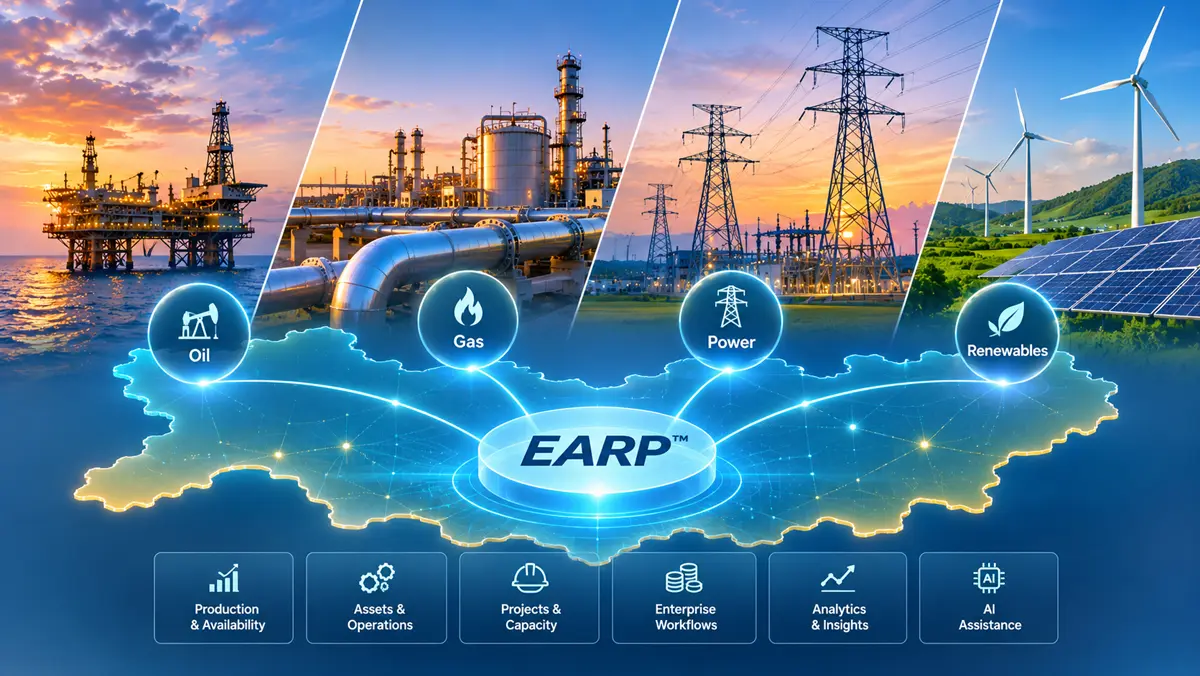
One national view, built on four energy verticals
EARP is organised around Oil, Gas, Power and Renewables. Its platform model presents sector-specific solution areas on a shared enterprise foundation. Each vertical retains its operational context while drawing on common platform capabilities where appropriate.
| National energy vertical | Connected production and operations |
|---|---|
| Oil | Exploration and production activity, well and asset performance, production surveillance, field operations and maintenance. |
| Gas | Gas production, facilities, pipelines, LNG and PNG operations, maintenance coordination, planning and operational reporting. |
| Power | Generation performance, available capacity, grid and utility operations, asset health, reliability and field activity. |
| Renewables | Solar, wind, hydro and storage asset output, availability, project status, energy and emissions insights, and portfolio performance. |
The four-vertical model makes it possible to compare relevant national indicators without assuming that every sector operates in the same way. Shared definitions can support national reporting, while sector-specific workflows preserve the detail needed by the organisations responsible for each asset class.
From sector systems to a connected operating picture
A national view should not require every operator to abandon its existing systems. EARP's published platform approach is modular: connect relevant enterprise systems, operational sources and field data; contextualise the information; orchestrate workflows and approvals; then apply analytics and AI assistance where useful.
In a national implementation, this could allow authorised institutions to see comparable indicators while operators continue to manage their own assets and operations. Four information groups are especially useful:
Production and availability: Bring together validated production and generation submissions, asset availability, planned maintenance and unplanned outages. Source, timestamp, unit and reporting period should remain visible so users can interpret each figure correctly.
Infrastructure and operational events: Relate production and generation information to facilities, pipelines, grid assets, renewable plants, constraints and operational exceptions.
Projects and capacity additions: Track development and infrastructure projects, milestones, commissioning readiness and expected contribution to future supply.
Enterprise accountability: Connect exceptions and performance gaps to maintenance, procurement, contracts, project delivery, finance, HSE and compliance workflows.
A national picture should connect information to accountable action.
Bring sector data, asset context, project milestones and enterprise workflows into a shared operating picture, while keeping asset ownership, operational authority and approvals with the responsible institutions.
Talk to our teamWhy the shared enterprise core matters
A national energy picture is only useful if it can support follow-through. EARP's shared modules include Finance and Accounting, Procurement and Supply Chain, Human Resources, Projects and Portfolio, Contracts and Commercial, Assets and Maintenance, Customers and Stakeholders, and HSE and Compliance. These functions provide a common operating foundation across the four verticals.
For example, a national performance review may identify recurring generation shortfalls or persistent production constraints. The issue can be traced to the relevant asset or project, reviewed by the responsible organisation, and linked to maintenance, procurement, contract or project actions. The national layer provides visibility and coordination; the asset owner retains operational control and approval authority.
This connection is important because energy performance is shaped by more than operational output alone. Project delivery, equipment availability, procurement lead times, contract obligations and workforce readiness can all affect the ability to sustain or increase supply. A shared enterprise core can help make these dependencies more visible to authorised decision-makers.
AI and analytics as decision support
EARP's published AI approach includes AI-assisted exploration across authorised business context, forecasting and analytics, workflow assistance for summaries, routing and task coordination, and governed access with human review.
Applied to a national energy context, these capabilities could help authorised users explore production trends, compare sector performance, identify unusual changes, examine project delays and assess scenarios. They can help users investigate the information behind a trend and prepare decision support across multiple sector sources.
The quality of these outputs depends on data coverage, timeliness, definitions and integration quality. Analytics should make the basis of an insight clear, and AI-assisted outputs should remain subject to the access rules and review responsibilities established by the participating institutions.
Governance is the foundation of national trust
A national platform must distinguish operator-owned operational data, regulator submissions, public indicators and commercially sensitive information. Common definitions, reporting calendars, validation rules, data lineage, role-based access, audit trails and correction processes are essential to producing a national picture that institutions can trust.
The platform should not imply that all data is real-time. Reporting frequency and quality will vary by source and by the agreements governing access. A useful national indicator should therefore show where it came from, when it was updated, which unit and reporting period it uses, and whether it has passed the relevant validation process.
Nor should a national intelligence layer directly control production facilities or grid equipment. Its role is to connect information, expose exceptions, coordinate authorised workflows and support decisions. Operational control remains within the responsible operator's approved systems and procedures.
A phased route to national implementation
A practical programme can begin with a defined set of national indicators and a small number of participating institutions. Rather than attempting to connect every source and sector at once, the first phase should establish the information model, responsibilities and rules needed to create a trusted baseline.
1. Agree the national data model: Define priority indicators, units, reporting periods, source ownership and validation responsibilities.
2. Establish access and reporting rules: Confirm who can submit, view, validate and correct information, and how commercially sensitive data will be protected.
3. Connect priority sources: Integrate selected operational and enterprise sources from participating institutions, preserving the source and timestamp of each data item.
4. Validate the national picture: Reconcile production and availability information, identify data gaps and agree how exceptions will be handled.
5. Add workflows and analytics: Introduce project tracking, exception coordination and decision-support capabilities as data quality and institutional adoption mature.
Cloud or customer-controlled deployment choices should be assessed against national security, infrastructure, connectivity and data-residency requirements. The deployment model should follow the requirements of the participating institutions and the national operating environment.
From fragmented reporting to connected national energy intelligence
National energy performance is shaped by the interaction of production, infrastructure, asset reliability, projects and institutions across Oil, Gas, Power and Renewables. EARP's four-vertical model, shared enterprise core, configurable workflows and context-aware AI provide a platform foundation for connecting these dimensions.
The objective is not another reporting portal. It is a trusted national operating picture that helps decision-makers understand what is happening, see where attention is required and coordinate action, while preserving the responsibilities of operators, utilities and regulators. The strength of that picture will depend on the quality of the underlying data, the clarity of institutional agreements and the ability to connect insight to accountable work.