For steel producers and the companies that import or trade their products, the EU Carbon Border Adjustment Mechanism (CBAM) makes emissions information part of trade, production and financial decision-making. Companies need to substantiate the embedded emissions associated with covered goods and understand the related compliance and cost exposure. That requires more than a carbon calculation: it requires a traceable connection between production routes, precursor inputs, finished products and exported shipments.
CBAM makes carbon data a trade and production issue
The EU CBAM definitive regime has applied since 1 January 2026. For steel value chains, the challenge is demanding because embedded emissions depend on the production route, process boundaries, raw materials and relevant precursor inputs. Producers must be able to explain not only an emissions result, but how it was derived, which installation and production process it relates to, and which products and shipments it supports.
The underlying information is often distributed across plant systems, energy records, laboratory results, supplier declarations, production databases, ERP transactions, mill certificates and shipment documents. A standalone carbon calculator or a spreadsheet assembled at the end of a reporting period cannot, by itself, establish this complete evidence chain.
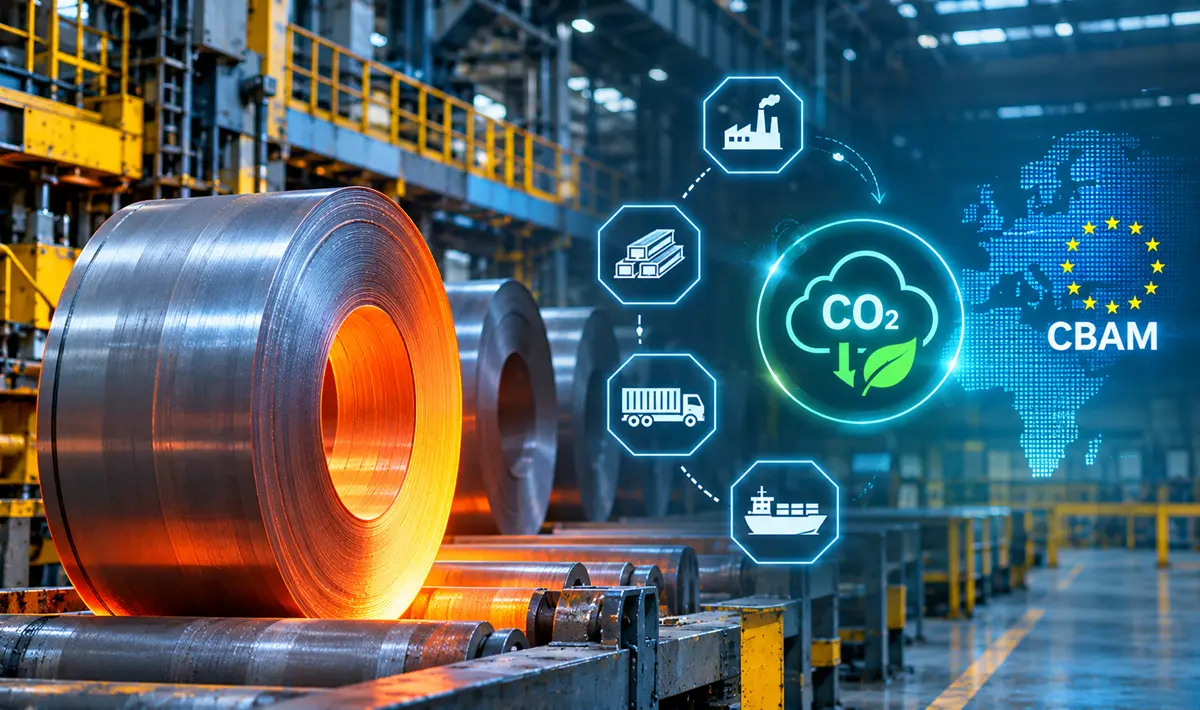
Steel's production routes require route-aware carbon accounting
Steel is not produced through one uniform process. Blast furnace-basic oxygen furnace (BF-BOF), direct reduced iron (DRI) and electric arc furnace (EAF) routes have different process steps, energy and material inputs, emissions sources and precursor relationships. Even within a route, product mix, operating conditions, fuel use, scrap composition and process configuration influence the information required for reliable accounting.
CBAM calculations need to follow the applicable goods classification, production route, system boundary, reporting period and precursor rules. The treatment of direct and indirect emissions is not identical for every covered good. The definitive-period rules for many iron and steel goods focus on direct emissions, while sintered ore and relevant precursor inputs have specific treatment. The applicable CN code and current methodology must be checked rather than applying one blanket factor to all steel products.
CBAM embedded-emissions accounting is also not interchangeable with a company's corporate Scope 1, Scope 2 and Scope 3 inventory. Product-level methodology, system boundaries, precursor treatment and allocation rules must be applied as prescribed for the goods being reported.
Build traceability from installation to shipment
A defensible process connects industrial production records to the commercial transaction. The data chain should link the installation and production route to material and energy inputs, production periods, heats or batches, finished products and exported shipments. This product genealogy is essential when a shipment contains products made across different heats, batches, grades, production periods or facilities.
A connected CBAM data workflow can follow six steps:
1. Connect: Collect installation, production, energy, supplier, trade and document data from approved enterprise sources.
2. Classify: Validate product descriptions and applicable CN codes; identify the installation, route, reporting period and relevant precursors.
3. Calculate: Apply configured CBAM methodologies, system boundaries, emission factors and allocation rules to determine embedded emissions.
4. Trace: Link the calculation to heats, batches, products, quantities and shipment records.
5. Validate: Check completeness, consistency, supporting evidence, approvals, exceptions and calculation versions.
6. Report and assess: Prepare declaration-ready outputs, retain audit evidence and evaluate carbon-cost exposure and improvement scenarios.
Where AI changes the work
AI can reduce the manual effort involved in assembling and interpreting fragmented information, but it should operate within a governed carbon-accounting framework. Practical applications include:
Document intelligence: Extract structured fields from mill certificates, supplier declarations, invoices, production records, energy statements and emissions reports.
Data mapping and reconciliation: Match supplier and installation records with internal material, production, product and shipment references; flag duplicates and inconsistent units or periods.
Evidence and anomaly detection: Identify missing documents, implausible values, unusual emission intensities, gaps in precursor data and mismatches between production and shipment quantities.
Product genealogy assistance: Help associate heats, batches, grades and finished products with the relevant installation and shipment, while routing uncertain matches for review.
Carbon and financial intelligence: Identify process and supplier hotspots, compare route or product scenarios, and estimate certificate-cost exposure using controlled assumptions and current applicable inputs.
AI should not independently invent emission factors, determine legal applicability or silently alter reported values. The calculation engine must use configured and version-controlled methodologies, factors, allocation logic and regulatory rules. Every reported result should retain its source evidence, extracted values, validation status, calculation version and approval history. Human review and accredited verification remain distinct control points.
Build carbon traceability into the production record.
Connect plant, supplier, energy, laboratory, production and shipment evidence so product-level emissions results can be traced, validated and assessed within a governed carbon-accounting workflow.
Talk to our teamEvery reported result should retain its source evidence, extracted values, validation status, calculation version and approval history.
From compliance evidence to commercial intelligence
A traceable carbon record can serve more than a declaration. Steel producers can understand emissions intensity by installation, route, product family, heat or batch; identify high-impact processes and suppliers; and evaluate operational or sourcing changes. Importers and traders can consolidate supplier evidence, assess shipment exposure and manage exceptions. Suppliers can provide structured installation and production information rather than repeatedly responding to disconnected data requests.
The financial layer translates verified or clearly qualified emissions data into scenario-based exposure. It can compare the impact of production routes, precursor choices, energy sources, product mix and carbon-reduction projects. These scenarios help commercial and operations teams understand where data quality, carbon intensity and cost exposure intersect. They are decision-support estimates, not substitutes for the authorised declarant's final calculation or regulatory filing.
The next competitive capability is evidence-led steel intelligence
The strategic shift is from reporting carbon after production to creating traceable carbon evidence as production and trade records are generated. A shared intelligence architecture can connect plant data, supplier information, embedded-carbon calculations, product genealogy, shipments, validation and financial scenarios. A common platform core can support other CBAM sectors through separate, validated sector methodologies, while steel requires its own route-aware data model and calculation logic.
For the steel industry, AI's greatest contribution is not producing a faster carbon number. It is helping establish a reliable chain from source evidence to product and shipment, surfacing exceptions before they become compliance problems, and turning carbon data into actionable operational and commercial insight. In a carbon-regulated market, the ability to prove the number and act on what it reveals becomes a competitive capability.