Industrial companies have spent years digitising assets, connecting equipment and deploying enterprise applications. Yet critical work still depends on people moving between disconnected systems, interpreting technical information, following procedures, coordinating teams and making decisions under time pressure. AI assistants can help with individual tasks, but isolated assistants do not automatically become a dependable operating capability.
The next workforce shift is not simply automation
The emerging opportunity is to build a digital workforce: a structured set of AI-enabled roles that work alongside employees, each with a defined purpose, domain knowledge, authorised tools, operating boundaries and measurable responsibilities. The objective is not to replace industrial expertise. It is to make that expertise more accessible, repeatable and scalable.
Why industrial enterprises need a workforce model
A generic chatbot may answer a question. An industrial Digital Employee must understand the context of the work, use approved information, follow the right workflow, produce evidence and know when a human decision is required. This distinction matters where an incorrect recommendation or unauthorised action can affect safety, reliability, production, service continuity or product quality.
A workforce model provides the structure around AI capability. Each Digital Employee can be defined by:
- Identity and role, with clear objectives and responsibilities
- Knowledge and memory relevant to its domain
- Skills and authorised tools
- Workflows, policies and operating boundaries
- Escalation rules and runtime evaluation
The AI model is one component; the employee is the governed operating entity.
Design the digital role, not just the AI agent.
A dependable industrial Digital Employee combines domain knowledge, authorised tools, defined workflows, operating boundaries and clear human escalation. Governance is part of the role from the beginning.
Talk to our teamWhere a digital workforce can support industry
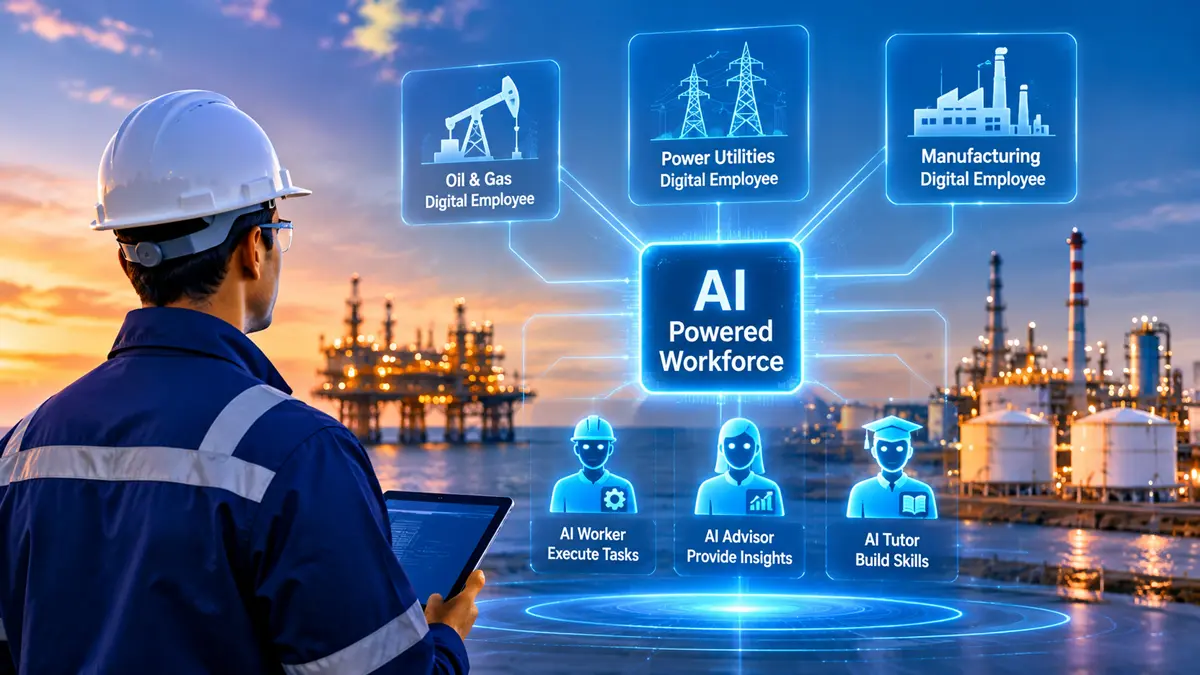
Oil & Gas: connect technical expertise to operational work
Across upstream, midstream and downstream operations, specialist knowledge is spread across well files, production reports, reservoir studies, drilling records, maintenance systems, engineering documents and operating procedures. Digital Employees can be configured for defined work such as production surveillance support, well and intervention analysis, drilling or petrophysical information review, facility workflow coordination and technical knowledge retrieval. They can assemble relevant context, prepare structured analysis, identify exceptions and route recommendations for review. Operational authority remains with designated personnel and approved systems.
Power, Utilities & Renewables: strengthen reliability and coordination
Utilities manage interconnected assets and time-sensitive work across generation, transmission, distribution and renewable portfolios. Digital Employees can support grid and asset information analysis, reliability workflows, outage coordination, maintenance planning, renewable integration studies and operational reporting. By connecting approved data and tools to role-specific workflows, they can reduce the effort involved in gathering information and coordinating action, while preserving engineering review, control-room procedures and safety boundaries.
Process Manufacturing: improve execution from plant to quality
Manufacturing operations combine production schedules, process parameters, quality results, maintenance history, engineering changes and supply constraints. Digital Employees can support production and process analysis, quality investigation, maintenance coordination, plant reliability, engineering change workflows and operational excellence. They can help teams assemble evidence and follow repeatable work packages, while quality releases, process changes and safety-critical decisions remain subject to the plant's approval framework.
What makes this different from deploying more AI agents?
The difference is lifecycle management and governance. A platform approach defines digital roles, builds domain capability, connects authorised tools and enterprise systems, manages execution, evaluates work quality and records evidence. AI Workers can execute defined tasks and repeatable work packages; AI Advisors can analyse information and recommend actions; AI Tutors can support knowledge transfer and workforce readiness. These roles operate within an enterprise workforce structure rather than as disconnected experiments.
This also changes how value is measured. Instead of counting chat sessions or agents deployed, companies can assess:
- Cycle time for defined workflows and time spent searching for information
- Quality and completeness of work products
- Exception-resolution time and adherence to procedures
- Human rework
- The proportion of tasks completed with appropriate evidence and approvals
Measures should be selected against a baseline and validated in each operating environment.
Enterprise control is a design requirement
Industrial AI must respect the organisation's data boundaries, intellectual property, operational technology constraints and accountability structures. AWP describes an enterprise-controlled, 100% on-premises deployment model, with model and vendor agnosticism, enterprise ownership and control of data and knowledge, and contractual treatment of enterprise-specific IP co-ownership. Its stated design principles include human accountability, controlled authority, evidence-based AI, approvals and auditability. Actual deployment scope, integrations and contractual arrangements should be confirmed for each enterprise.
A practical adoption path begins with one role
Select a recurring task with accessible data, a clear owner and measurable friction. Define what the Digital Employee may read, recommend, prepare or execute; specify approvals and escalation; connect only the required systems; then evaluate quality, reliability and business impact before extending to adjacent roles.
This avoids scaling an unproven agent and creates a controlled route from pilot to a managed digital workforce.
From isolated assistance to enterprise capacity
The industrial AI opportunity is moving beyond individual copilots and task-specific bots. Oil & Gas, Power Utilities and Manufacturing companies can build a more durable capability by treating AI as a workforce to be designed, equipped, supervised and continuously evaluated. Human expertise supplies context, judgement and accountability; Digital Employees add capacity for information-intensive and repeatable work.
The result is not an automated enterprise without people, but a more capable enterprise in which people and governed AI roles work together.