Industrial assets rarely fail without warning, but the signals are often subtle. A pump may draw more current, a compressor may take longer to reach operating pressure, a motor may run hotter or a bearing vibration signature may gradually change. Because operating conditions, product mix, ambient temperature, control settings and sensor quality also affect the data, an isolated signal can be difficult to interpret. Physics-Informed Neural Networks (PINNs) offer a way to combine operational evidence with engineering relationships to support earlier, more credible asset-failure prediction.
The limits of data-only prediction
Conventional machine-learning models learn patterns from historical examples. They can be effective when representative failure data is plentiful and operating conditions remain familiar. In industrial settings, however, labelled failures are often scarce, failure modes evolve and equipment may operate outside the conditions represented in model training data.
A model can therefore produce a confident prediction without adequately reflecting the physical behaviour of the equipment. Load, process configuration, ambient conditions and sensor quality can all influence what a reading appears to show. Reliable prediction needs to distinguish a genuine change in asset condition from normal variation in how the equipment is being used.
What a Physics-Informed Neural Network adds
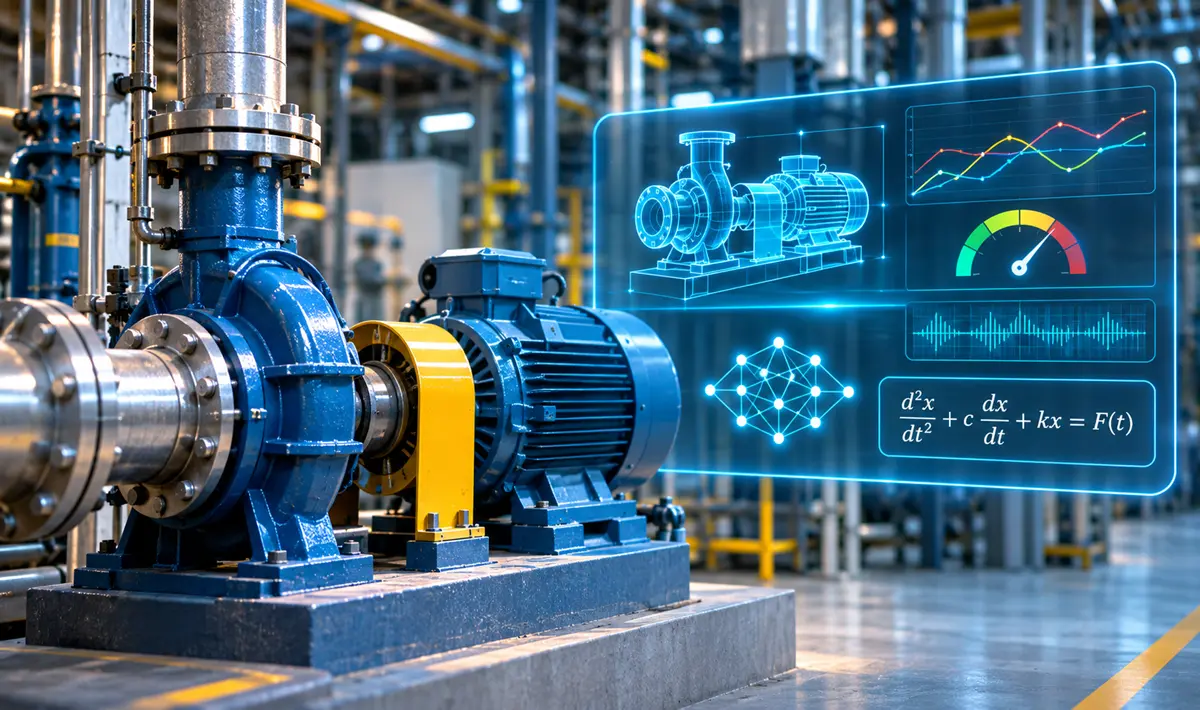
A Physics-Informed Neural Network combines data-driven learning with known physical relationships. Rather than learning only from input-output examples, the model is trained with additional constraints derived from governing equations, conservation principles, equipment characteristics or validated engineering relationships. These constraints encourage predictions to remain consistent with how the asset should behave.
For rotating equipment, relevant knowledge may include mass and energy balances, pressure-flow relationships, torque and power relationships, thermal dynamics, rotor behaviour and process-specific constraints. The exact equations depend on the asset, its configuration and the quality of available engineering information. A PINN does not replace a detailed engineering simulator. It provides a way to embed selected physics into a learnable model that can work with operational data.
This can be valuable where failure examples are limited. Physics constraints can narrow the range of plausible behaviour, help learning across operating regimes and make model outputs easier to interrogate. They do not guarantee accuracy: incorrect assumptions, incomplete equations or poor sensor data can still lead to misleading results.
From sensor signals to degradation intelligence
A practical architecture begins with reliable, time-aligned operating data from sensors, control systems, maintenance records and asset context. Data-quality checks address missing values, drift, calibration issues, timestamp alignment and changing operating states. Engineered features such as rates of change, operating-window statistics, pressure differentials, temperature gradients, load-normalised measures and event-based indicators can reveal behaviour that raw readings alone may hide.
The PINN learns relationships between observed signals and the physical constraints selected for the asset. Its output need not be a single failure/no-failure label. A more useful design can estimate latent degradation or health states, track a health index, identify likely failure mechanisms and estimate failure probability over defined time horizons. Remaining Useful Life (RUL) can be estimated where the data, failure history and operating context support a defensible forecast.
For example, a pump's increasing pump-down time can be assessed alongside pressure behaviour, motor current, temperature, shaft speed and cleaning events. A change in one variable may simply reflect a different operating load. A coordinated deviation across several signals, inconsistent with expected pump physics, may provide stronger evidence of developing degradation. The model should explain which signals and constraints contributed to the assessment.
Why hybrid intelligence is stronger
PINNs are not a universal replacement for other analytical methods. Asset reliability can benefit from a portfolio of complementary techniques, each addressing a different part of the problem:
- Anomaly detection identifies unusual behaviour that warrants investigation.
- Supervised models classify known failure patterns where labelled examples are available.
- Temporal models capture changes and relationships across operating sequences.
- Survival analysis supports time-to-event estimation.
- Bayesian methods represent diagnostic uncertainty.
- Statistical process monitoring detects sustained shifts in operating behaviour.
- Physics-informed learning constrains predictions using selected engineering knowledge.
Combining these methods can provide a more complete view of what is changing, how equipment may be degrading, which failure modes are plausible, how risk is evolving and how much useful life may remain. Disagreement between models should be treated as a signal for investigation, not hidden by forcing a single answer.
Connect AI predictions to the physics of the asset.
Combine sensor evidence, equipment context and selected engineering constraints with complementary analytical methods. Give maintenance teams interpretable health trends, risk horizons and supporting evidence, while keeping engineering validation and approval within the operating workflow.
Talk to our teamTurn prediction into an accountable maintenance decision
The value of failure prediction is realised only when it changes a decision. Health trends and risk horizons can help maintenance teams prioritise inspections, plan spares, schedule controlled shutdowns and avoid unnecessary interventions. Alerts should include confidence or uncertainty, the evidence behind the result and the operating context, together with recommended checks. They should not be reduced to a red warning or an unexplained RUL number.
Engineering judgement remains essential. PINN outputs should be validated against known operating regimes, historical events, controlled tests and field observations. Models require monitoring for sensor drift, equipment modifications, changes in process conditions and degradation patterns not represented during development. Calculations that determine safety limits, protection actions or regulatory obligations should remain within approved engineering and control systems, with human authority clearly defined.
The next generation of asset reliability will not come from AI alone or physics alone. It will come from combining operational evidence, engineering constraints and disciplined maintenance workflows.
A practical path to adoption
Start with one critical asset class and a clearly defined failure problem. Establish a baseline from existing condition-monitoring and maintenance practices, map the asset's operating envelope, identify the physical relationships that can be credibly represented and assess whether the available sensor and event data are adequate.
Develop the model in shadow mode and compare predictions with inspections and confirmed outcomes before connecting it to operational workflows. Measure lead time, false alarms, missed events and maintenance usefulness. This provides a basis for deciding whether the model is ready for operational integration and where further data or engineering work is required.
From prediction to engineering-led reliability
Physics-informed learning offers a bridge between operational data and engineering knowledge. Used alongside complementary analytical methods and disciplined validation, it can help identify subtle changes, assess plausible degradation mechanisms and present maintenance teams with more useful evidence. Its contribution depends on the quality of the data, the credibility of the physical relationships and the way its outputs are governed.
The objective is not to replace engineering judgement with an algorithm. It is to move asset failure prediction beyond pattern recognition towards physically informed, explainable and decision-ready intelligence, with authorised professionals retaining accountability for maintenance and safety-critical decisions.