GHG Reduction Calculations
Quantify greenhouse gas savings by bringing operational data, emission factors and baseline scenarios into one consistent, verifiable calculation workflow.
Explore the use case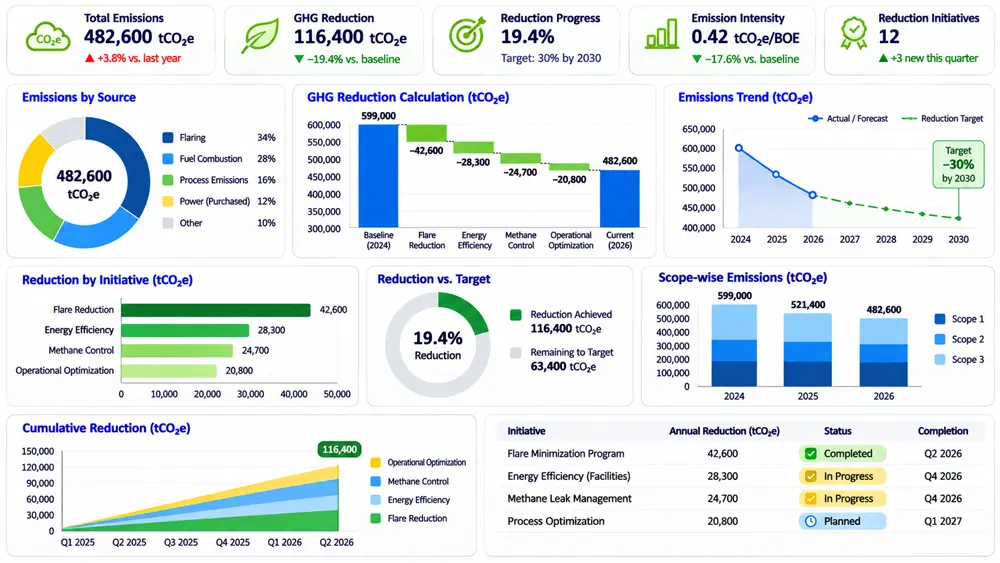
Inconsistent data and manual methods make GHG reductions difficult to verify.
Organizations need reliable calculations to demonstrate emissions savings. Spreadsheet-based processes, fragmented operational data and outdated emission factors make results difficult to reproduce, compare and defend during audits.
Outdated Factors
Outdated emission factors and inconsistent methodologies can produce unreliable estimates that fail regulatory or audit scrutiny.
Fragmented Data
Energy meters, fuel logs, production systems and process data are spread across sources, increasing complexity and reporting delays.
Manual Calculation Errors
Spreadsheet-driven calculations are prone to human error and are difficult to repeat consistently across multiple sites.
Limited Audit Evidence
Without transparent baselines and traceable inputs, teams struggle to prove reported reductions to stakeholders and regulators.
An AI-driven engine for consistent and verifiable GHG reduction calculations.
The reduction engine unifies fragmented activity data, standardizes calculation methodologies and compares emissions against defined baselines to produce repeatable results and traceable evidence across reporting cycles.
Automated Data Capture
Ingest data from IoT sensors, smart meters, ERP systems and production logs to build a unified calculation dataset.
AI-Based Calculation Models
Apply updated emission factors, material balances and activity data to generate consistent GHG reduction outputs.
Baseline Scenario Comparisons
Quantify actual emissions savings against historic or business-as-usual reference scenarios.
Evidence Packaging
Assemble timestamped records, metadata and traceable calculation inputs for internal review and external verification.
From operational activity data to verified emissions savings.
The calculation workflow consolidates energy, fuel, production and emissions-factor information to produce comparable GHG reduction results across facilities, production lines and supply chain partners.
Input Data
Energy readings, fuel logs, production throughput, emission factors and activity data from connected operational sources.
Final Output
Standardized reduction reports, baseline comparisons, evidence bundles and submission-ready documentation.
Deployment Platform
A secure cloud platform with APIs, dashboards and automated updates for emission factors and methodologies.
Processing Scope
Facilities, production lines and supply chain partners, supporting consistent and comparable reduction calculations.
Measure. Compare. Verify.
Operational activity data is standardized, compared against a reference baseline and packaged with traceable evidence.
A connected workflow for repeatable GHG reduction calculations.
Consolidate Activity Data
Bring together energy readings, fuel logs, production throughput, emission factors and operational activity data.
Calculate & Compare
Apply calculation models and standardized methodologies, then compare results against historic or business-as-usual baselines.
Package Evidence
Generate reduction reports, baseline comparisons and timestamped evidence bundles for review and verification.
Delivered through CarbonSense™, combining automated data capture, AI-based calculation models, baseline comparisons and traceable evidence packaging in one secure workflow.
Making emissions savings more reliable, comparable and transparent.
The AI-driven reduction solution improves the accuracy, consistency and transparency of GHG reporting, helping organizations demonstrate progress against sustainability targets while lowering compliance costs and audit-related risks.
Higher Calculation Accuracy
Automated data capture and AI-based models improve the reliability of reduction calculations across sites.
Consistent Methodologies
Standardized baselines and updated emission factors support repeatability and comparability across reporting cycles.
Audit-Ready Evidence
Timestamped evidence bundles simplify third-party verification and reduce audit preparation effort.
Enhanced Stakeholder Confidence
Transparent and reliable reporting strengthens credibility with regulators, investors and sustainability stakeholders.
CarbonSense™
Emissions tracking, compliant MRV reporting and efficient carbon credit management.
Ready to quantify and verify your emissions savings?
Let's explore how AI-driven GHG calculations can improve consistency, transparency and audit readiness.
Discuss this use case