Cyber-Physical SCADA Threat Detection
Correlate cyber and operational anomalies across utility networks to identify coordinated threats, accelerate incident response and safeguard critical grid operations.
Explore the use case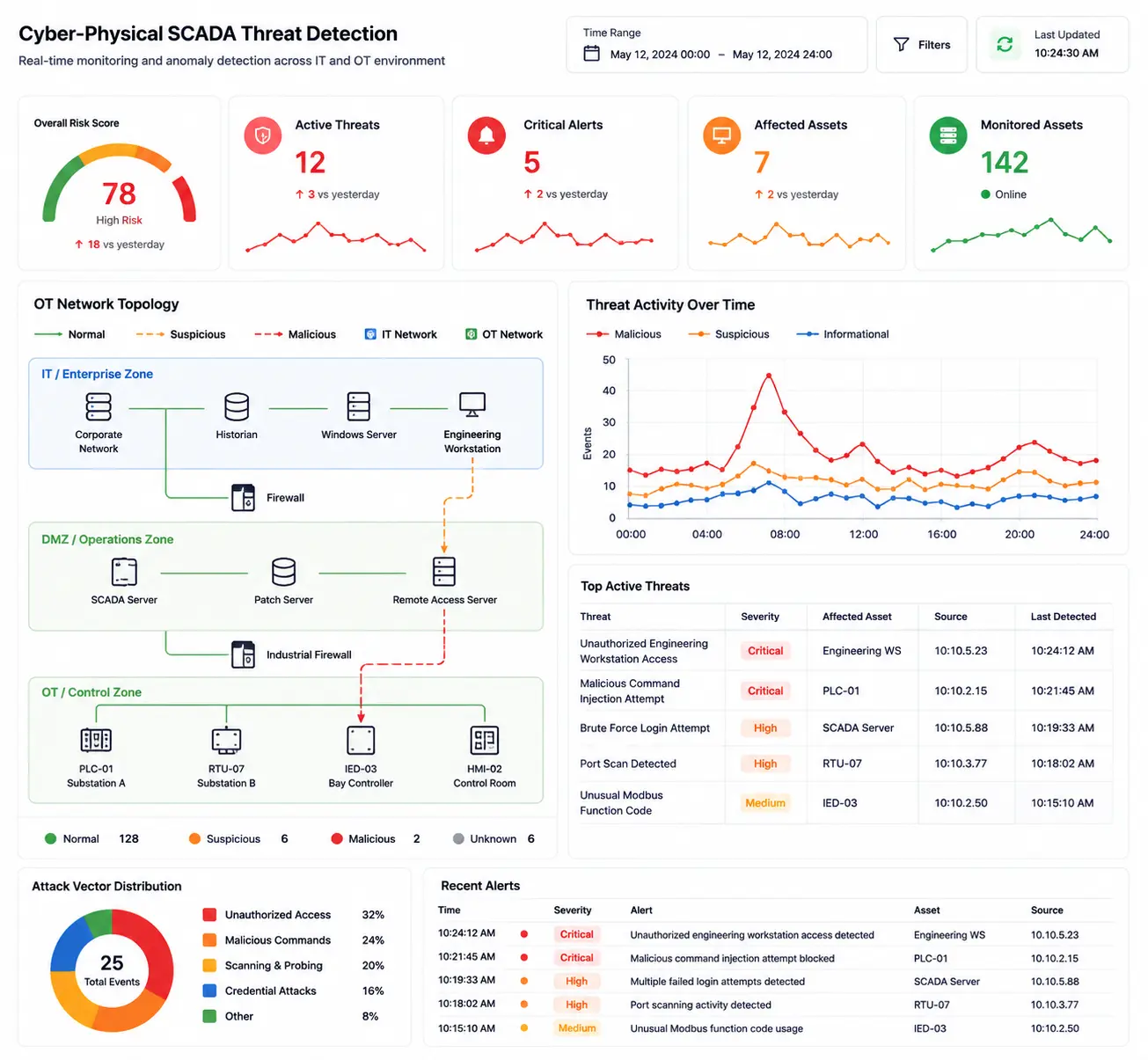
Fragmented OT and IT visibility leaves critical grid operations exposed.
Cyber intrusions and operational anomalies can threaten SCADA infrastructure. When OT and IT monitoring operate in silos, utilities may miss coordinated attack patterns and abnormal control activity. Delayed detection can increase the risk of service disruption, safety hazards and compliance gaps.
Fragmented Monitoring
Separate OT and IT tools create blind spots when identifying coordinated, cross-domain attack patterns.
Abnormal Control Activity
Switching irregularities and unusual command sequences can be difficult to detect without predictive intelligence.
Compliance Complexity
Inconsistent cyber incident reporting makes alignment with critical-infrastructure security guidelines harder to demonstrate.
Delayed Threat Detection
Limited real-time visibility into SCADA events can increase mean time to detect and respond to incidents.
Hybrid AI detection connects operational anomalies with cyber threat intelligence.
A hybrid detection pipeline combines OT anomaly detection with IT signature analysis to provide continuous cyber-physical monitoring. Correlating signals across grid operations, control systems and IT networks helps identify suspicious activity and route prioritised alerts to response teams.
OT Behaviour Monitoring
Analyse switching irregularities, unusual load behaviour and unexpected command flows within operational technology systems.
IT Signature Detection
Integrate Snort and Suricata intrusion detection signatures to identify malicious network activity and strengthen cyber threat coverage.
Cross-Layer Event Correlation
Correlate anomalies across grid operations, control systems and IT networks to flag potentially coordinated cyber-physical attack scenarios.
Automated Incident Workflows
Route alerts to SOC/NOC teams with incident tagging to support prioritisation, investigation and faster response.
From SCADA and network telemetry to prioritised security alerts.
The monitoring pipeline brings operational logs, IoT telemetry and network packet information together for anomaly detection, threat correlation and incident reporting across utility environments.
Input Data
SCADA logs, IoT telemetry and network packets streamed through syslog and intrusion detection system sensors.
Detection & Correlation
OT anomaly models and IT signature analysis identify unusual behaviour and correlate events across operational and network layers.
Final Output
Real-time anomaly alerts, compliance dashboards and SOC-linked incident reports for prioritised response.
Deployment Scope
Monitoring across multiple substations and control centres, including simulated and blocked SCADA cyberattack scenarios.
Unified Visibility Across OT & IT
Correlate operational anomalies and network threat signatures to support faster incident triage.
A connected workflow from event collection to coordinated incident response.
Operational and network signals are collected, analysed and correlated before alerts and incident details are shared with the teams responsible for security and grid operations.
Collect OT & IT Signals
Stream SCADA logs, telemetry and network events through syslog and IDS sensors.
Detect & Correlate Threats
Apply OT anomaly detection, IT signature analysis and cross-layer event correlation.
Alert Response Teams
Send prioritised, tagged incident alerts to SOC/NOC teams for investigation and response.
The source deployment describes an ELK Stack environment for log management, visualisation and AI-enhanced detection pipelines.
Faster threat detection and stronger resilience for critical grid infrastructure.
By connecting OT and IT visibility, the cyber-physical monitoring framework helps utilities detect threats in real time, coordinate incident response and strengthen security governance across SCADA environments.
Prevented Breach Attempts
Blocked three SCADA intrusion attempts in real time, avoiding downtime and asset compromise.
Stronger Compliance Alignment
Achieved alignment with CERT-In and NCIIPC guidelines for critical infrastructure.
Reduced Detection Time
Lowered mean time to detect (MTTD) by 60% through automated correlation and alerting.
Improved Operational Resilience
Enabled utilities to proactively secure SCADA infrastructure against evolving cyber threats.
Reported outcomes are taken from the source case study. The source does not specify the measurement period or a broader financial impact.
GridSense™
AI-powered utility intelligence connecting grid operations, monitoring and analytics to support resilient power networks.
Looking to strengthen the cyber resilience of your utility network?
Explore how AI-powered cyber-physical monitoring can improve threat visibility, accelerate incident response and help safeguard SCADA operations.
Discuss this use case