LAS Curve Prediction & QC at Scale
Automating well-log quality control and reconstructing missing curves across large LAS and DLIS archives.
Explore the use case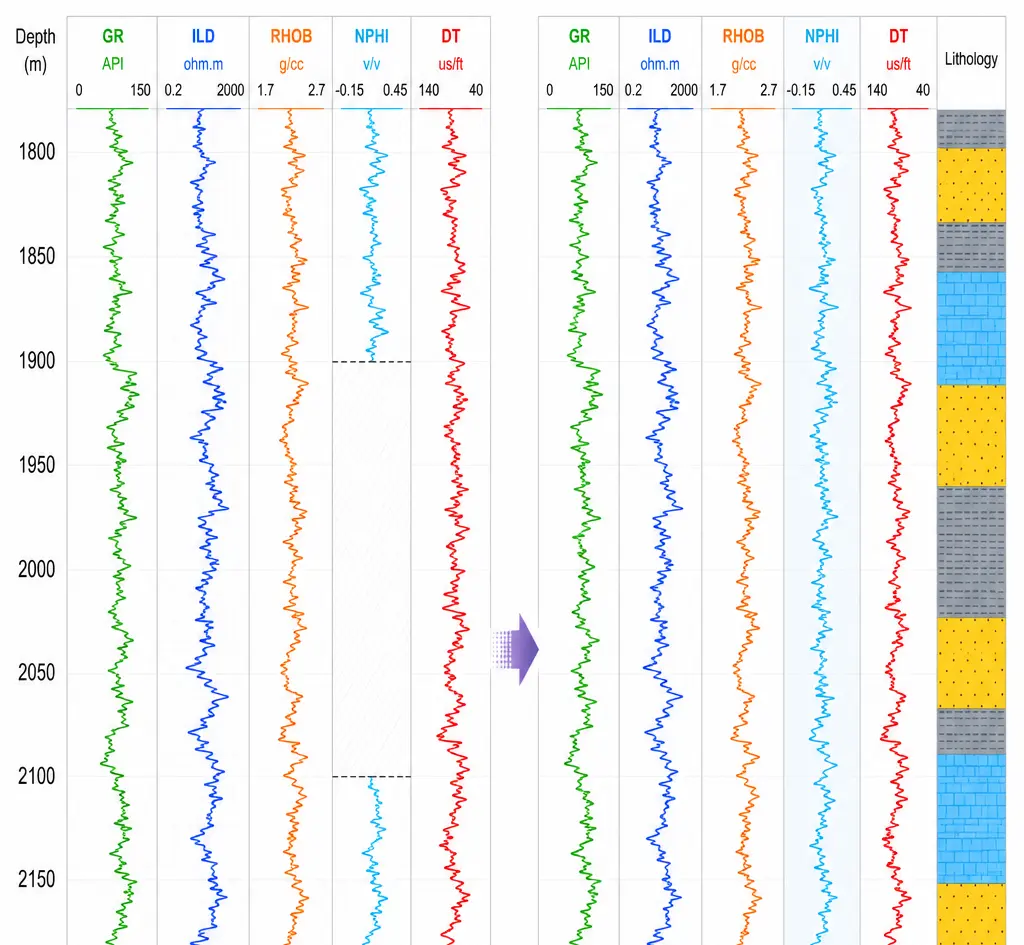
Incomplete and inconsistent well logs slow down subsurface analysis.
Large legacy well-log archives contain missing, misaligned and noisy data, limiting reliable petrophysical analysis and modeling.
Missing Curves
Incomplete GR, DT and NPHI curves affect well-log interpretation.
Inconsistent Headers
Metadata and curve naming differences create schema mismatches.
Data Anomalies
Null values, sharp spikes and broken log intervals complicate QC.
Manual QC Effort
File-by-file cleaning is time-consuming and can introduce inconsistent results.
A hybrid AI workflow for curve prediction and log quality control.
The approach combines machine-learning prediction, metadata validation and anomaly detection to automate LAS/DLIS quality checks and curve reconstruction.
ML-Based Curve Prediction
Random Forest and Gradient Boosting models reconstruct missing GR, DT and NPHI curves.
Metadata & Schema Validation
Regex checks and PPDM schema rules validate and standardize curve headers.
Anomaly Detection
Identify and flag null values, spikes and broken log intervals for quality review.
Batch QC Processing
Apply automated checks and normalization across large LAS and DLIS file collections.
From large log archives to standardized, QC-ready well data.
The workflow was applied across more than 100,000 LAS and DLIS logs from multiple fields, basin types and well vintages.
Input Data
Over 100,000 LAS and DLIS logs from multiple fields, basin types and well vintages.
Processing Scope
LAS 2.0/3.0 and DLIS formats, with batch automation and field-scale normalization.
Final Output
QC-checked logs with predicted curves and standardized headers, ready for downstream ingestion.
Predicted and standardized well-log curves
Reconstructed curves and consistent log headers support downstream petrophysical and AI workflows.
Well-log QC workflow at a glance.
LAS / DLIS Input
Ingest well-log files from large legacy archives for batch processing.
AI QC & Prediction
Validate metadata, detect anomalies and predict missing GR, DT and NPHI curves.
Standardized Output
Generate QC-checked logs with predicted curves and standardized headers.
Delivered through LogiSense™, bringing curve reconstruction, log standardization and quality control together in a unified well-log data workflow.
Faster quality control and greater well-log data utility.
The AI-powered workflow reduced manual effort and accelerated the preparation of consistent datasets for downstream use.
QC Automation
Automation achieved in data quality checks across large legacy log libraries.
Faster Curve Cleaning
Log cleaning and validation time reduced from 30 minutes to less than 2 minutes per file.
Normalized Log Data
Standardized logs support field-wide analytics, machine learning and interpretation workflows.
Reported outcomes from this use case. Results may vary with data quality, file characteristics and processing requirements.
LogiSense™
AI-powered well-log intelligence for curve reconstruction, data quality control and petrophysical workflows.
Have a well-log data challenge to solve?
Let's explore how AI can improve your well-log quality control and data readiness.
Discuss this use case