AI-Powered Fault Detection
Detecting faults and structural discontinuities in 3D seismic data to accelerate interpretation and improve consistency across large seismic volumes.
Explore the use case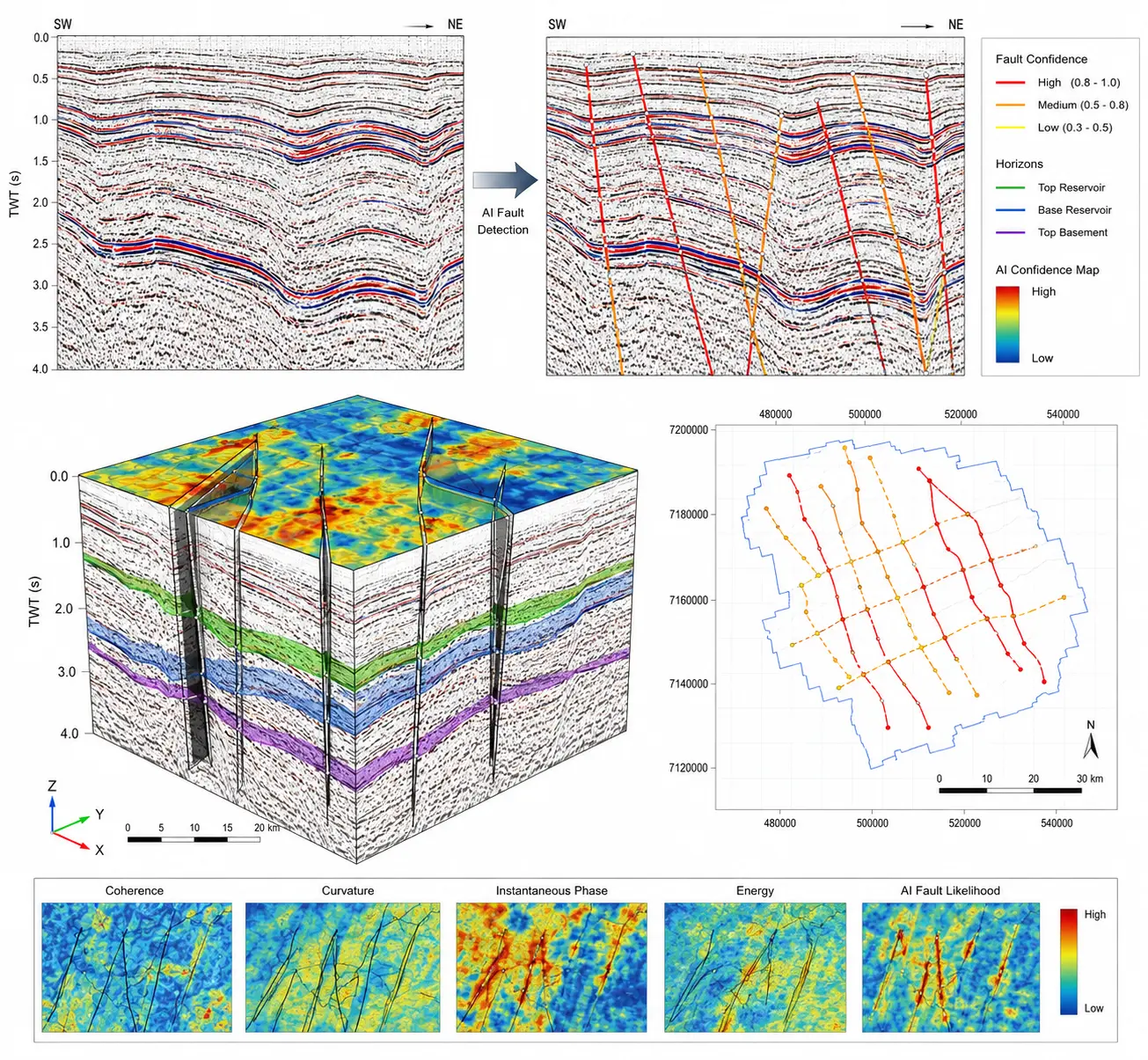
Manual fault interpretation slows the analysis of large 3D seismic volumes.
Accurate fault interpretation is essential for structural understanding, but traditional methods are slow, manual and heavily dependent on interpreter expertise, particularly when working with large 3D datasets and tight timelines.
Subjective Interpretation
Interpreter-dependent decisions, especially in low-quality seismic zones, can produce inconsistent fault frameworks.
Manual Mapping
Manual horizon picking and fault drawing slow exploration workflows and delay model updates.
Limited Scalability
Manual interpretation is difficult to scale across large volumes and multi-field or regional studies.
Slow Model Updates
Inefficient updates make fault modelling less suitable for iterative project decisions.
AI-driven detection of faults and structural discontinuities in 3D seismic volumes.
The AI-driven pipeline analyses 3D seismic volumes to identify fault-related discontinuities, combine fault probability outputs, and generate continuous fault surfaces and structural polygons for interpreter review.
CNN-Based Fault Detection
Detect fault-related discontinuities and amplitude curvature across 3D seismic volumes using convolutional neural network modelling.
Fault Probability Cube Merging
Combine outputs from multiple detection runs with confidence scoring to improve robustness and reduce noise.
Fault Skeletonization
Convert probabilistic fault volumes into continuous fault surfaces and structural polygons.
Interpretation Platform Integration
Prepare outputs for integration into interpretation platforms such as Petrel, enabling QC and further analysis.
From large 3D seismic volumes to interpreter-ready fault outputs.
The pipeline processed more than 250 GB of labelled training and inference data from 3D seismic volumes across multiple basins.
Input Data
3D seismic volumes from multiple basins, totalling over 250 GB of labelled training and inference data.
Processing Scope
Pre-stack and post-stack seismic inputs, CNN-based detection, probability cube merging and fault skeletonization.
Final Output
Fault probability cubes, confidence maps and skeletonized fault polygons ready for integration into interpretation platforms.
Fault Probability & Structural Interpretation
Fault confidence maps, skeletonized fault surfaces and structural polygons for interpreter QC and analysis.
AI-powered fault detection workflow at a glance.
3D Seismic Input
Load pre-stack and post-stack seismic volumes from multiple basins for model inference and analysis.
AI Detection & Fault Processing
Detect discontinuities, merge fault probability cubes with confidence scoring and skeletonize fault structures.
Interpreter-Ready Outputs
Deliver fault probability cubes, confidence maps and structural polygons for integration into Petrel and interpreter QC.
Delivered through SeisSense™, bringing AI-based fault detection, confidence mapping and structural output generation into an integrated seismic interpretation workflow.
Accelerating structural interpretation across large 3D seismic datasets.
The AI-driven pipeline reduces manual interpretation effort, improves consistency and helps exploration teams make faster decisions using large 3D seismic datasets.
Faster Structural Interpretation
Reduced fault mapping effort from several weeks to just a few hours through deep learning automation.
Improved Mapping Consistency
Applied standardized detection logic across the seismic volume to reduce interpreter bias.
Enhanced Exploration Agility
Supported near real-time decisions during prospect evaluation and license screening.
Interpreter-Ready Outputs
Generated Petrel-compatible deliverables for handover, detailed structural analysis and interpreter QC.
SeisSense™
AI-powered seismic analysis for fault detection, structural interpretation and subsurface understanding.
Have a seismic interpretation challenge to solve?
Let's explore how AI can accelerate fault interpretation across your seismic volumes.
Discuss this use case