Shop-Floor Scheduling & OEE Analytics
Balance workloads and expose bottlenecks across machines, cells and shifts with constraint-aware scheduling and real-time production analytics.
Explore the use case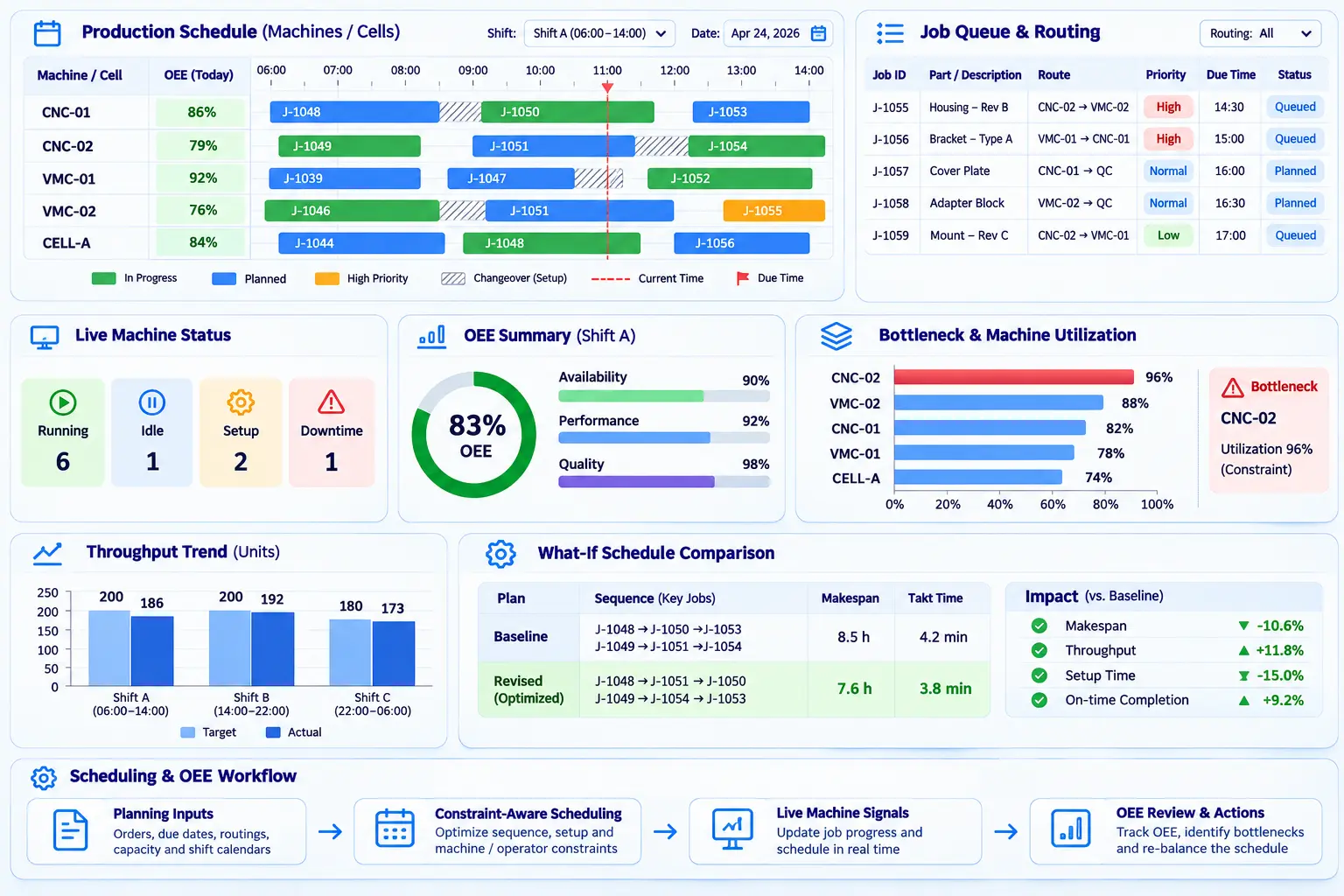
Manual scheduling struggles to keep pace with changing shop-floor conditions.
Manual boards and spreadsheets lack the flexibility to manage fast-changing production environments. When unexpected events occur, schedules become fragile, delays ripple through operations and delivery performance suffers.
Rigid Schedules
Machine breakdowns, rework loops and last-minute changeovers disrupt manual plans, creating idle time and wasted capacity.
Limited Live Visibility
Without current machine states and operator availability, planners struggle to maintain accurate schedules.
Hidden Bottlenecks
Constraints often become visible only after throughput drops, forcing teams into reactive firefighting.
Delivery & Cost Pressure
Missed due dates affect service levels, overtime costs rise and performance becomes difficult to track consistently.
Coordinate production with constraint-aware scheduling and OEE analytics.
An integrated scheduling and analytics platform improves visibility, dynamically balances workloads, uncovers hidden bottlenecks and identifies opportunities to increase throughput across complex shop-floor operations.
Constraint-Aware Scheduling
Prioritize jobs by due date, setup families and operator availability to balance workloads and support throughput.
Live Machine Signals
Automatically update job status from machine signals, reducing manual board updates and keeping schedules current.
OEE Dashboards
Consolidate availability, performance and quality to expose bottlenecks that reduce operational efficiency.
Scenario Planning
Run what-if analysis to test schedule changes before committing them to production.
Connect production plans, machine states and shift data in one scheduling view.
The deployment combines planning inputs and live shop-floor information to generate optimized run lists, planned changeover blocks and OEE reports for production visibility.
Input Data
Job queues, routings, takt-time targets, machine states and shift calendars provide the basis for scheduling decisions.
Final Output
Optimized run lists, planned changeover blocks and OEE/throughput reports provide visibility across the shop floor.
Deployment Platform
A scheduling and analytics platform provides a browser-based interface, exports and system integrations.
Processing Scope
Single-cell through multi-plant views, with APIs connected to MES, ERP and historian systems.
From Production Inputs to Actionable Plans
Live machine status and planning constraints inform run lists, changeover plans and OEE/throughput visibility.
A connected workflow for dynamic scheduling and performance analysis.
Consolidate Planning Inputs
Bring together job queues, routings, takt-time targets, machine states and shift calendars.
Balance & Test Schedules
Apply scheduling constraints, refresh job status from live signals and evaluate what-if scenarios.
Monitor Shop-Floor Performance
Provide optimized run lists, planned changeovers and OEE/throughput reports for operational review.
Delivered through ForgeSense™, supporting shop-floor scheduling, machine-level visibility and OEE analytics across production cells and plants.
More stable plans, better throughput and clearer operational visibility.
The AI-driven scheduling and analytics solution helps stabilize production plans, improve throughput and make efficiency and cost drivers more visible, supporting proactive decisions and stronger resource utilization.
Reduced Idle Time
Schedules adapt to changing conditions, reducing idle time across constrained production assets.
Improved On-Time Delivery
More realistic schedules and proactive bottleneck management support improved delivery performance.
Increased Throughput
Smoother job flow across machines and cells helps ease bottlenecks and stabilize output rates.
Clear ROI Visibility
OEE dashboards and cost-per-part trends make efficiency gains more transparent to management.
ForgeSense™
Smart CNC and shop-floor intelligence for coordinated production, operational visibility and manufacturing efficiency.
Ready to bring greater visibility to your shop floor?
Let's explore how connected scheduling and OEE analytics can support more reliable production planning.
Discuss this use case