Sensor-Driven Adaptive Machining
Protect tools and stabilize surface finish with live machining parameter control that responds to changing cutting conditions while staying within OEM-safe limits.
Explore the use case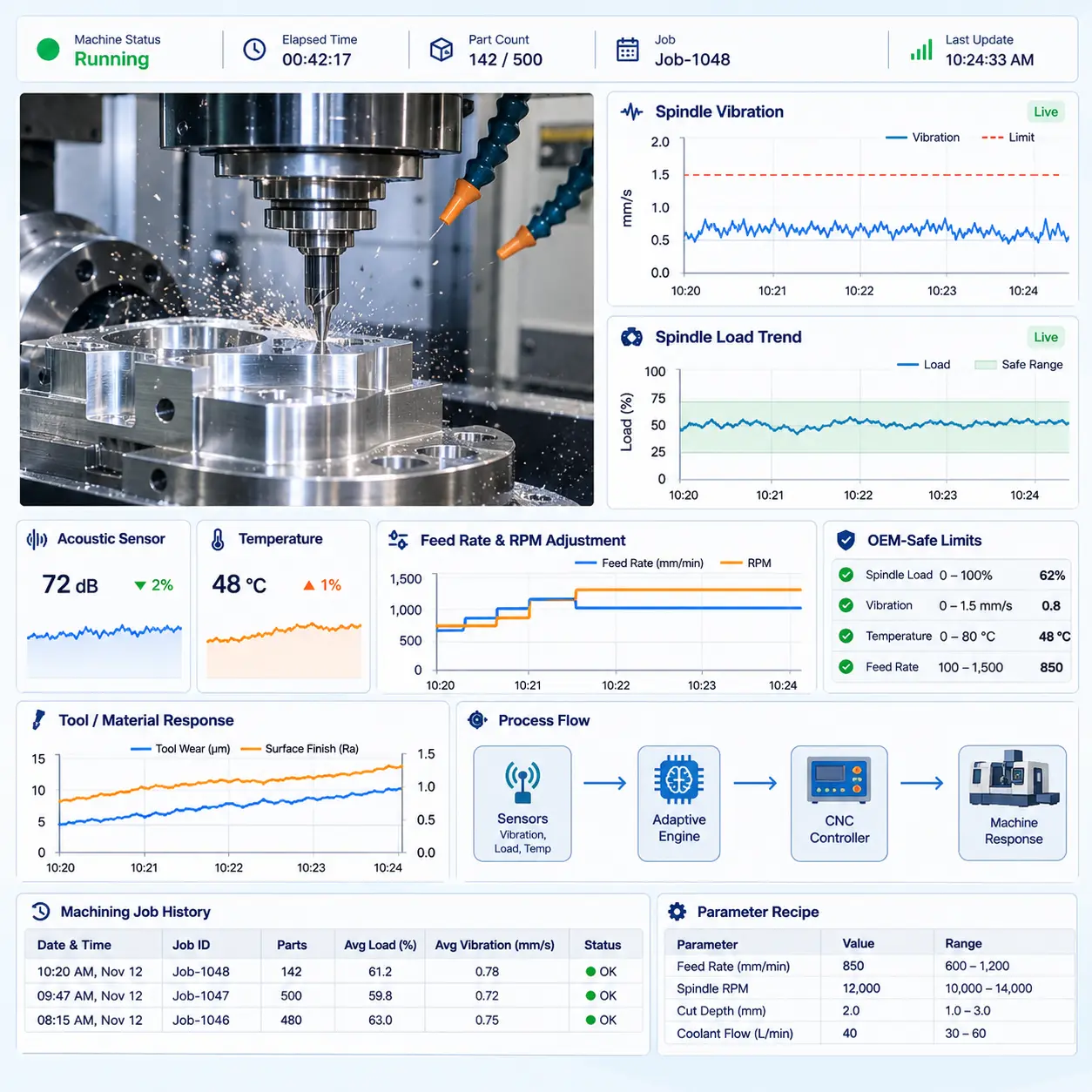
Fixed machining parameters cannot respond to changing cutting conditions.
Traditional CNC programming applies fixed parameters, but real-world conditions change continuously, introducing risks to productivity and quality. Without adaptive control, manufacturers face higher costs and inconsistent outcomes.
Fixed Feed & Speed Settings
Fixed settings ignore real-time variations and can lead to sudden load spikes that break tools and damage parts.
Unstable Surface Finish
Changing cutting conditions can cause finish drift, additional passes, rework and extra post-processing.
Manual Operator Adjustments
Manual compensation creates inconsistent practices across shifts, machines and operator experience.
Longer Cycle Times
Conservative settings applied broadly can sacrifice machining efficiency to avoid tool damage.
Live parameter control guided by real machining conditions.
An adaptive control engine senses operating conditions, adjusts machining parameters live and optimizes tool life and part quality while supporting finish-critical machining operations.
Multi-Sensor Monitoring
Continuously monitor vibration, spindle load, acoustics and temperature to guide adaptive parameter adjustments.
Live Feed & RPM Tuning
Adjust feeds and RPM as cutting loads shift unexpectedly to stabilize surface finish and protect tooling.
OEM-Safe Limits
Enforce controller-specific safety envelopes so adaptive changes remain within certified operating boundaries.
Job Learning
Capture tool and material response data to build reusable parameter recipes for future runs and repeat jobs.
From live machine signals to safe, adaptive machining adjustments.
The Adaptive Engine connects sensor streams and controller data to tune machining parameters in real time and retain the learning from each job.
Input Data
Sensor data streams, controller tags, tool and material presets, and thermal operating limits.
Processing Scope
Milling and turning centers, multi-spindle lines and finish-critical machining operations.
Final Output
Dynamic parameter adjustments, event logs and reusable recipes to improve repeatability across jobs and part families.
Sense, Adjust & Learn
Controller-safe real-time tuning connects live operating conditions with machining parameter adjustments.
A closed-loop adaptive control workflow for machining operations.
Monitor Machine Conditions
Read vibration, spindle load, acoustic and temperature signals alongside controller tags and operating limits.
Adjust Parameters Safely
Tune feed and RPM in real time while enforcing controller-specific OEM-safe boundaries.
Record & Reuse Learning
Capture event logs and tool/material response data to build reusable recipes for future jobs.
The Adaptive Engine connects through controller-safe protocols such as OPC-UA to support real-time, closed-loop tuning.
More stable machining, protected tooling and repeatable quality.
The adaptive machining system reduces variability, protects tooling and supports faster throughput while lowering operating costs and improving confidence across machining environments.
Shorter Cycle Times
Cycle durations decreased on steady production jobs without compromising quality or process stability.
Fewer Tool Failures
Tool breakage events declined, lowering consumable costs and reducing unexpected downtime.
Consistent Surface Quality
More stable Ra values and tighter dimensional tolerance on finish-critical features.
Smarter Future Runs
Learned parameter recipes improve repeatability across jobs, machines, materials and operators.
ForgeSense™
AI-powered manufacturing intelligence for CNC programming, adaptive machining and shop-floor operations.
Looking to protect tools and stabilize machining quality?
Explore how ForgeSense™ can help adjust machining parameters in response to live operating conditions.
Discuss this use case